
1. Introduction
This article makes the case for further research on transgender people’s use of active travel, including how differing modes contribute to experiences of marginalisation, as highlighted in previous transmobilities research (Lubitow et al., 2017; Lubitow, Abelson and Carpenter, 2020; Shakibaei and Vorbojovas-Pinta, 2022; Weintrob et al., 2021) as well as experiences of liberation and ordinariness (Smith, forthcoming). We also suggest that centring trans1 lives and knowledges can help deepen understanding of how gender and sexuality shape experiences of active travel and public space. Normative concepts of gender often remain invisible where non-normativity is not studied, yet (for instance) assumptions about appropriate displays of masculinity limit possibilities for people of all genders to enjoy public space, including through racialised exclusions (c.f. Osei and Aldred, 2023).
This article outlines an infrastructural approach that sees mobility as a substantial component of everyday flows of care and neglect that enable and constrain life in the city. Within transport planning, “infrastructure” usually means networks of roads, railways, cycle lanes, and footways that materially underpin movement and travel. These are the material means through which movement occurs, although often analysed by scholars as themselves social and political (e.g. Xie and Spinney, 2018). In urban planning, the idea of social and cultural infrastructure is now often used to consider the materiality of spaces such as parks, libraries, and LGBTQ+ venues (Campkin and Marshall, 2017; Klinenberg, 2018; Rodekirchen and Phinney, 2021).
By contrast, this paper draws upon infrastructural approaches that do not foreground material underpinnings (although these are important) but rather relationally constituted flows or webs of care (and neglect) that sustain the social reproduction of trans and queer life (Berlant, 2016; Campkin, 2020; Hall, 2020; Malatino, 2020; Power and Mee, 2020). This type of infrastructural lens expands the focus from the mobility space itself to the relational formation of these spaces and the lived experiences of inhabitants. It highlights flows of care and neglect that supplement and ground movement, such as housing (Power and Mee, 2020), and spaces of community (Campkin, 2020).
This infrastructural lens is not intended to supplant other relational perspectives on mobility, such as the commoning of mobility, which sees mobility as a shared practice and public good (Nikolaeva et al., 2019). It complements such perspectives by attending to the politics of everyday transmobilities and by challenging narrower, more individualised understanding of transgender emerging through its incorporation into planning through an “equalities” paradigm (see Smith, Gilchrist and Lim, 2023). An infrastructural lens engages with the specificity of trans experiences while contributing to wider research and policy agendas. It opens up conversations about how active travel policies and low-carbon transportation agendas can be gender-sensitive beyond the cisgender binary. By foregrounding lived experiences of mobility for transgender inhabitants, an infrastructural lens can also contribute to discussions about how to move towards trans liberation (see Todd, 2023a).
The paper explores these issues through two sections. Section 2 reviews relevant research and theory, including on queer and trans infrastructures, and work specifically on trans experiences of public space and public transport. It concludes by reflecting on what these literatures can contribute to an active travel research agenda that is beginning to incorporate trans experiences and perspectives. Section 3 draws on MCS’s doctoral work to provide insights from researching the everyday movement and experiences of trans people in Brighton, UK. In this research, mobility was explored in terms of everyday modes of movement through non-virtual space undertaken by trans inhabitants of the city and its surroundings. The section provides examples of documentary and interview-based analysis showing how an infrastructural approach to active mobilities centres relations of care and neglect that shape trans people’s everyday life in the city, concluding by reflecting briefly on directions that could be taken by future research.
2. Situating trans experiences: infrastructures, spaces, transport
2.1 Queer and Trans Infrastructures and Flows
The growth of research exploring queer experiences and perspectives has, as indicated above, been shaped by the “infrastructural turn” within sociology. This turn helped to create new connections between apparently “private” and “public” domains by constructing and questioning networks, materials, and distributions. Within feminist and queer studies, the concept has highlighted the material nature of concepts and relationships hitherto analysed as symbolic or cultural. For instance, writing about infrastructure in the context of intimacy, Wilson (2016) says:
Infrastructure is a systematic assemblage of objects, codes, and procedures that, whether it fails or succeeds, is often an embedding environment for intimate life. [Infrastructure is] a constructed (real) techno-material-symbolic assemblage that, at least in intention, underpins, enables, and conditions the context for more visible enactments, some intended by explicit norms and some more or less transgressive appropriations. (p. 274)
“Infrastructure” is a way of seeing the world, linking structure and movement across domains. Berlant (2016) describes infrastructure as the movement or patterning of social form. Hall (2020) and Power and Mee (2020) emphasise that the processes and politics of care relations are integral to social reproduction and are often marginalised if there is only a focus on the technical, material, and symbolic dimensions of infrastructure. Foregrounding relations of care and neglect and how they produce, augment, and inhibit mobility can provide a fruitful starting point to consider wider sets of power relations that influence experiences of mobility spaces for marginalised inhabitants.
Recent work conceptualising queer venues, networks, and events as infrastructure has in part sought to shift away from a focus on transience (traditionally associated with queerness) to the embedding of people and things in times and places, including material structures like specific buildings. For instance, Campkin (2020) describes London’s queer venues as “highly charged symbolic networks that bring people and services together”. Such networks of belonging (citing Muñoz, 2009), Campkin argues, can link past, present, and future, illuminating the “not-yet-here”. However, such infrastructures and networks can be threatened; for instance, when building Crossrail – a major new railway line through central London – bricks and mortar queer venues in the city were destroyed. Campkin explains how naming such places as “LGBTQ+ infrastructure” can make them more tangible, helping to resist threats to their existence.
While Crossrail could be seen as transport infrastructure threatening queer infrastructure, transport infrastructure can itself be overtly coded as queer. During London’s Pride month (June), Crossrail and other parts of the Underground network have been temporarily festooned with rainbow flags. Rainbow or trans flag images are used to decorate more permanent “hard” transport and public realm infrastructure. Bain and Podmore (2023) write about their use to designate pedestrian crossings in Canada, commenting that it embodies “the municipal technocratic comfort with ‘hard’ infrastructure as opposed to the messier embodied politics of ‘people as infrastructure’” (p. 13) (see Simone, 2004). In other words, authorities find it easier to paint crosswalks pink, purple and blue than to engage with and provide for their trans populations.
Broader work on transport infrastructure does incorporate such infrastructures as covering social networks, activities, and events (e.g. Lugo, 2013), like walking buses, tours, and training. Examples of such queer social/transport infrastructure include LGBTQ+ walking tours or Women and Gender-Variant bike workshops. Beyond this, understanding transport as “social infrastructure” can go beyond looking at cultural events or “supplemental infrastructure” (Barajas, 2020) to explore meanings and processes embedded in the everyday. These meanings may be long-standing, current, or temporary; more public, or more hidden. For instance, we might think about trains carrying groups going to join a Pride march (see Turesky and Crisman, 2023), or Irish people living in the UK in 2015 taking the ferry to vote for Equal Marriage and then celebrate publically.
Transport infrastructures such as streets, bus stops, and subway lines can be queered on a more individual, contingent, and transient basis. Weintrob et al. (2021) write: “A show of affection in the street or on the bus can be construed as a brave spatial act that fractures the assumed ‘straightness’ of that space, although this is precarious” (p.785). Queer histories may be invisible to the uninitiated, yet for someone “who was there”, an apparently unexceptional transport corridor may connect them intimately to vanished pasts. Fannin (2023) describes how even when bars and clubs are long-lost, walking through those now-changed streets can ignite stories and experiences. These might include metro journeys ending at a gay club held one night of the week, walks through places used as meeting areas or cruising grounds, or bike routes through a city’s historic or current queer district.
Such routes and spaces may be memorialised through objects like the AIDs Memorial (“Tay”) in Brighton’s New Steine Gardens, through community knowledge, or through personal memories. Paul Harfleet’s Pansy Project2 plants that flower at sites of homophobic and transphobic abuse, memorialising victims and mapping often under-reported violence. Trans communities have set up intra-community flows of care to staunch flows of violent neglect, which are often led by Black activists. For instance, a North American Black trans man in 2019 set up the Black Trans Travel Fund to fund safe travel alternatives for Black trans women in need, recognising that the cheapest travel options are often unsafe (Black Trans Travel Fund, 2023). This is an example of a self-organised trans care mobility infrastructure arising to address an acute unmet need for safe travel.3 It belongs within what Malatino (2020) calls co-created trans and queer “care webs”, networks of mutual aid that reach far beyond feminism’s traditionally domestic and reproductive-focused approach to care.
2.2 Trans Experiences of the City/Public Space
An infrastructural lens on trans experiences of active travel can draw on emerging research into both city space and public transport (see 2.3 below). Even if situated outside the mobilities field, research into trans experiences of city-space has often implicitly covered transit and mobility (see Doan, 2010; Edelman, 2014). This has primarily focused on how trans people encounter readings of their body and racialised harassment and violence often associated with being trans in “public” spaces. Researchers have developed concepts to characterise ways in which planning, policy, and public attitudes interact to shape experiences of being trans in public. Azzouz and Catterall (2021) propose the idea of “Authorised Public Space Discourse” to characterise the web of assumptions and working practices of organisations that co-determine how public spaces are organised, accessed, and used. This might include ways in which planning decisions encourage (or challenge) the commodification of the “gaybourhood”, where LGTBQ+ venues become spectacles for heterosexual visitors.
Namaste (1996) uses the term genderbashing to describe the violent enforcement of gender normativities in public space and the overlooked and under-researched violence towards transgender people. Relatedly, Doan (2010) refers to “the tyranny of gender” to express how the assumption of cissexuality and transphobia polices movement, visibility, and behaviour to marginalise and stigmatise trans bodies across public and private spaces. Increased awareness and trans representation in some domains of public life have been accompanied by ongoing racialised and highly spatialised processes of (non)disclosure, self-regulation, hypervisibility, and hypervigilance (Edelman, 2009; Stanley, 2017; Todd, 2021).
Such processes generate a varied but nevertheless inhibited use of city-space, constituting the spatial expression of cisheteropatriarchy (see Valentine, 1989). A study in New York City used the idea of spatial stigma to research variation within trans experiences of public spaces (Lampe et al., 2020). The authors found a complex map of potentially stigmatising areas including public transport, stores, and restaurants, interacting with the race and gender of the trans individual. Such intersectional axes of marginalisation create specific experiences of oppression, disproportionately harming trans Women of Colour (Edelman, 2014). Concepts such as trans misogynoir (Krell, 2017) can further help to explore the specificities of multiple axes of marginalisation in public space. Trans sex workers are another group for whom regulation and policing co-produces acute vulnerabilities to violence (Edelman, 2011; Sabsay, 2013; Ritterbusch, 2016).
Other research highlights frequently shared trans experiences that affect everyday travel and use of public space. Many transgender and non-binary people plan travel around perceived bathroom access (Dubin et al., 2021), as a space that is often concretely and discursively gendered (Marshall, 2021). Hence, as for many disabled people (Kafer, 2013), trans people’s mobility is augmented by adequate toilet provision and restricted where this does not exist along public transport and active travel routes. Access to appropriate health care also commonly shapes trans people’s everyday mobilities. For some, this necessitates regular travel to other cities (Browne and Lim, 2010), while for others it may mean visiting parts of a city that they otherwise avoid (Smith, 2024).
Vulnerabilities both entail oppression and form the basis for resistance (Brice, 2020). Todd (2023a, 2023b) emphasises—against exhausting hostility in public and private realms—the resilience, affirmation, and joy sustaining trans youth. Trans joy has been markedly understudied as a form of resistance and as a contributor to wellbeing, with research often focusing first and foremost on marginality and negativity (Shuster and Westbrook, 2024). Such a focus may also reinforce a dysphoria/euphoria binary, which Malatino (2022) queers by exploring the potential of a range of negative affects from which forms of solidarity can emerge. Trans people of all ages enact practices of care within co-created safer spaces, often temporary and at least semi-private (Browne, Bakshi and Lim, 2011; Gieseking, 2022; Malatino, 2020). These acts and networks of solidarity may happen in homes (England, 2022), community spaces, and licensed venues (Campkin and Marshall, 2017) amongst others. However, their precarity in the face of long-standing “austerity” was demonstrated during the Covid-19 pandemic (Rodekirchen and Phinney, 2021).
2.3 Transmobility and public transport
Mobility in urban space for trans people is co-constituted by transportation infrastructures and flows of care and neglect in the governance and policing4 of these and surrounding spaces. Increasingly, research has explored trans experiences of public transport (Lubitow et al., 2017; Lubitow, Abelson and Carpenter, 2020; Shakibaei and Vorbojovas-Pinta, 2022). Public transport may help fulfil trans people’s right to everyday life in the city (Beebeejaun, 2017); but this right is often threatened. Lubitow et al. (2017) use the term “transmobilities” to characterise transgender transit user experiences, introduced as:
a specific form of non-hegemonic mobility whereby multiple intersecting forms of oppression impact the movements, behaviours, and emotions of transgender and gender nonconforming transit users. […] being a gender minority on public transit requires a different sort of movement – a mobility that is informed and shaped by cissexism as well as other intersecting systems of oppression. (p.1399).
Lubitow et al. (2017), Lubitow, Abelson and Carpenter (2020) and Shakibaei and Vorbojovas-Pinta (2022) interviewed transgender users of public transport systems: Lubitow et al in Portland, USA; and Shakibaei and Vorbojovas-Pinta in Istanbul, Turkey. Interviews explored positive and negative experiences of public transit, with participants in both studies highlighting discrimination, harassment, and violence. For most participants interviewed by Lubitow et al. (2017), a good experience was neutral or forgettable. One participant, Sydney, stated, “As long as everybody leaves me the hell alone, lets me go home, I am thrilled” (Lubitow et al., 2017: p. 1404).
Weintrob et al. (2021) write about the “hidden costs” for LGBTQ+ people to travel safely, specifically “identity and visibility compromises and heightened levels of fear”. As described by “Cassie” (2009, quoted in Weintrob et al., 2021), “Public transport is frightening: a) because you can’t get away and b) because people are sitting [and] looking around them so you’re more likely to be noticed” (p.783). This creates a constant expectation of trouble; in participant Lana’s words, “There is a place in me knowing that something is approaching.” (p.781). Canadian research confirmed that trans people’s wellbeing was negatively impacted not just by prejudicial events but by the stress associated with anticipating such prejudice (Aversa et al., 2022).
Lubitow et al. (2017), Lubitow, Abelson and Carpenter (2020) and Shakibaei and Vorbojovas-Pinta (2022) found that public transport was a space of hypervigilance. Trans users are visible and immobile while waiting at sites such as bus stops and rail platforms. Once on trains or buses, vulnerability is experienced through the confined proximity to potentially hostile others. With limited access to cars or taxis, and lacking alternatives, many research participants had developed safety and coping strategies such as travelling in groups, not travelling at certain times, or getting off before or after their stop. Shakibaei and Vorbojovas-Pinta (2022) highlight how such strategies impact access to other infrastructure, for instance impeding access to entertainment sector venues that often provide employment as well as leisure facilities. For trans people in the UK, Weintrob et al. (2021) found that
greater differences were revealed between day and night-time travel, with all transport being rated “very unsafe” at night. Only a few trans* people felt “very safe” on public transport, both in the day and at night. All participants identified as trans* (n = 23) selected “unsafe” or “very unsafe” when describing walking at night. In contrast, 79% (n = 22) of lesbian women and 46% (n = 50) of gay men felt “unsafe” or “very unsafe” walking at night. (p.782).
The authors highlight negotiation strategies including taking the bus infrequently to avoid waiting at bus stops, sitting downstairs close to the driver, and travelling as a group.
Research on public transport has thus begun to mobilise the concept of mobility justice for LGBTQ+ and trans people which means not just “increasing accessibility for different transport modes across the city, but attending to how the characteristics of certain modes of travel exclude marginalised groups of people” (Lubitow, Abelson and Carpenter, 2020, p. 6). Mobility justice researchers have argued for interventions that can provide increased flexibility and/or make services more responsive to the needs of LGBTQ users. These include educational and promotional strategies (Lubitow et al., 2017, Lubitow, Abelson and Carpenter, 2020; Shakibaei and Vorbojovas-Pinta, 2022), reducing fares, improving journey opportunities around LGBTQ events and venues, flexible alighting from buses at night, and escorting, carpooling or taxi services (Weintrob et al., 2021, pp. 786–787).
2.4 Activating Transmobilities
As Nachman, Hayhurst and Wang (2024), state, “there is a notable gap in research that considers the cycling experiences of those with diverse gender identities”, and this holds for other active modes, such as walking or “micromobility”. Building on the emerging research on public transport, such research could also draw on the larger amount of work (see section 2.2 above) on discrimination and harassment experienced by trans people in public space. The public space research is, however, not usually conducted through a mobility or transport planning lens and is generally more pertinent to walking than to other active modes.
One recent exception is Cubells et al. (2025), who explore queer women (cis and trans) and non-binary people’s experiences of walking and cycling in Barcelona. Cubells et al. write of how “LGBTQIA+ people reoriented the city towards their own needs, paving new routes that defy normativity”. For instance, participant “Olivia” describes how despite an experience of sexual assault, she chooses visibility over cisnormativity, regularly strolling with queer friends as a form of care and social resistance. Participants in the study who cycled talked about how its faster pace could alleviate social discomfort, with speed protecting them from some potential negative social intersections. Exploring the lived experience of material infrastructures, the paper explores how the distinct local spatialities of cycling and walking permit differing forms of affect, structured through intersectional social identities. The authors suggest that “safe cycle lanes could be seen as a crucial part of queer infrastructure, allowing access to the city while alleviating discomforts.”
While Cubells et al (2025) examine cis and trans experiences of walking and cycling, research is still lacking that focuses on cycling as a form of everyday mobility for trans people (c.f. Newhall (2021) and Barras (2021) on trans people’s participation in competitive cycling). This remains an important research gap given the distinct nature of cycling as a faster mode of travel than walking, which (as Cubells et al. suggest) may afford increased motility (potential for movement) at times when immobility feels most precarious. As Sybil Collas (2019) states in True Trans Bike Rebel, a collection of personal reflections on active travel, “When you go too fast for strangers to take your silhouette in, the vision that remains in them is that of a blurry and undefined person. But in my mind, the image is always clear. I’m not a rider or a walker, not really. I’m the movement in between.” (p.37).
Conversely, Lubitow, Tompkins and Feldman (2019) found that increased visibility experienced while cycling could heighten gendered and racialised harassment and discrimination. Their one trans-identified participant, a young African American trans man, said he could not afford to purchase a bike and so relied on the city’s bikeshare scheme. He suggested that East Portland (where much of the city’s Black population live) lacked the infrastructure provided in other areas, and that gentrification rather than care for residents drove both active and public transport provision. A mobility justice approach to transmobilities implies considering relationships between mobility and transportation and other infrastructures such as housing, displacement of residents through gentrification, and supplemental social infrastructure such as community organisations (c.f. Barajas 2020).
In line with wider histories of transport planning, contemporary discourses around cycling come with their own normative prioritisations (Aldred and Jungnickel, 2014; Aldred, Woodcock and Goodman, 2016). For instance, the commute (conceptualised as an A to B ride from home to work) is typically prioritised in cycling and broader transport planning, feeding through into London’s Cycle Superhighways that initially sought to build for routes from Inner London residential districts to the city’s Central Business District. Lam’s (2018) study argues that without explicit consideration of race (and other intersections), cycling interventions may “raise the profile of already-visible privileged cyclists for whom cycling is a lifestyle choice while further erasing ‘invisible cyclists’ for whom cycling is an economic necessity” (p. 115).
Thinking infrastructurally about cycling prompts a consideration of complex material and social relations that can enable and inhibit its use. This includes exploring how transmobilities such as cycling are enabled through social support infrastructure and constrained by cissexism and transphobia. While it is important to explore negative and neutral experiences, research studying how and if trans people experience joy and affirmation while travelling actively is also needed. Positive affects, such as joy, were noted by Pedroso and Aldred (2023) among Women of Colour cycling, and it is important not to close the possibility of such positive experiences (not least, to consider how such experiences might be supported and generalised). The next section provides some examples of what this approach might look like, using data collected as part of MCS’s PhD research.
3. Trans and Active Mobility Infrastructures in Brighton
3.1 The Study Context: trans infrastructures in Brighton and Hove
This section presents data extracts from the first author’s PhD project, using mixed qualitative methods to research transgender experiences in Brighton & Hove (Smith, 2024). The project explored concepts and experiences of trans infrastructures, seeking to contribute to transfeminist planning praxis and hence to creating a more sustainable world for trans people. It included documentary analysis of policy documents and interviews with urban planners, alongside creative cartographic methods in which participants drew, annotated, and talked about local places of comfort and connection with other LGBTQ+ people and infrastructures.
While not specifically focused on mobilities, this emerged as an important theme within the thesis, with transmobilities and mobility infrastructures figuring both as connecting spaces of care, and as important in themselves. This section draws on the PhD project and research to provide some examples of what an infrastructural approach can offer active travel research, in understanding the place of transport as social as well as physical infrastructure within trans people’s everyday mobilities. The section also aims to point towards how planning can think beyond equalities and make trans inhabitants of the city safer, more connected, and more joyous.
The study took place in the City of Brighton and Hove (henceforth “Brighton”). It is a popular seaside resort, with 300,000 inhabitants on the South Coast of England, 90 km or an hour’s train ride South of London. Brighton has 10.7% of adults reporting a sexual orientation other than heterosexual in the 2021 Census, which is three times higher than the national average. For many years, the city has been sold and/or perceived as the “gay capital of the UK” (Browne and Lim, 2010). In wider terms, Brighton is seen as socially liberal and votes accordingly. Between 2010–24, while the UK was run by Conservative-led administrations, Brighton’s three Parliamentary constituencies returned Labour and Green MPs. However, the scope for local administrations to buck national trends is limited. Brighton sits within highly centralised nation-state structures, and lacks the additional devolved powers enjoyed by London and some city-regions (e.g. health care devolution).
Brighton makes more overt attempts to support trans inhabitants than many English local authorities. For instance, in 2015 it published a Trans Needs Assessment (Hill and Condon, 2015). This was and is unusual. Focusing more on areas like health care and housing, the report said little on transport and mobility, although recommending visibility initiatives and training of local bus operators’ staff. There remains a lack of consideration of trans people’s mobility in relation to wider wellbeing and ability to inhabit city space. While local urban planning does not completely ignore trans+ people, it articulates trans selectively into policy. This relies on individual champions and is primarily conducted through impact assessments that do not proactively seek to reduce inequalities (Smith, Gilchrist and Lim, 2023). Moreover, there often remains an absence of trans voices and experiences; with big data, consultants or Equality, Diversity and Inclusion (EDI) advocates acting as proxies (Brochu-Ingram, 2022).
Notwithstanding its limitations, Brighton attracts substantial LGBTQ+ migration from across the UK and beyond because of the perceived cultural acceptance, including better access to necessary health care services (Boden-Stuart et al., 2022). But it is not an affordable haven. Housing in Brighton has long been expensive, and this was aggravated by the UK’s extended house price boom. In December 2003, the average property in the city cost £183,198 (37% higher than the British average of £133,703), while by January 2024, it was £423,772, 50% higher (than the average of £282,162)5. Rents are also locally high, in a wider national context of relatively high levels of private renting (around 20%) alongside relatively weak protections for tenants (BBC, 2018). From a mobility justice perspective, this implies that many residents, would-be or former residents are priced out, living in overcrowded accommodation, at the city edge and/or in satellite towns, with long and potentially risky journeys to see friends and access services. LGBTQ+ people may be particularly vulnerable to being pushed out in this way, given their greater vulnerability to poverty and homelessness (e.g., Bull et al, 2023).
An infrastructural account of trans mobilities directs our attention to mobility infrastructure as always both social and material. It brings together the materiality of city space with the felt and perceived flows of care and neglect that produce and augment the mode of travel and the experience of it. The following three sections reflect upon, respectively, walking, public transport, and cycling, as experienced by trans residents of Brighton and the surrounding area….
3.2 “A bit more in control of my environment”: Walking as self-care
Alex is a white trans woman in her 30s. In Brighton, she experiences a level of calm in her nervous system that she does not feel anywhere else, even London (which is also a city whose residents tend to have more accepting attitudes towards difference than the UK more generally). While safety is never absolute, she described Brighton as “the safest place I could be in”.
I tend to think that Brighton is probably the safest place that I’ve lived, and so I realise that every time I come back from somewhere else. For instance, on the train back from London, or whatever, then I get off the train and walk into the station and it’s almost like my body relaxes a little bit, my jaw unclenches my shoulders are a bit more relaxed because it feels like the safest place I could be in.
While much literature on queer experiences in public space (including transport networks) understandably highlights experiences of fear and of harassment, Alex’s extract below stresses the control and self-care that walking offers her, given the relative calm experienced in “the safest place”.
Well I walk, I pretty much walk everywhere […] walking has always made me feel the safest […] I think it has to do with the fact that you’re just constantly walking through space, so when you’re not stalling, when you’re not standing. It feels like also a good way to deal with the anxiety that can come from being in a public place. I’m thinking especially my first few years in Brighton were… I was visibly trans or visibly gender non-conforming, and transitioning that came with some worries and some anxieties […] I think walking for me was a way to have more control of the space around me, also because I’m very aware of the fact that if you’re on public transport […] you have to get off at a specific stop or whatever, you have very limited control over your environment and you’re much more likely to be harassed, and I just couldn’t deal with it so walking became also a way, not just to keep mentally sane and a bit active but also to feel like I was a bit more in control of my environment, like I could always walk faster, walk more slowly, manage space a little bit better.
For Alex, walking is more than a mode of travel. When faced with a heightened sense of danger, walking allowed Alex to access the city, its events, employment, and everyday services including the trans health care and queer communities that maintain, sustain and enable the collective thriving of trans life. As in Cubells et al. (2025), however, Alex’s walking freedom is moderated and mediated both spatially and by how she presents and is perceived, including whether she is alone or with a partner. It has also changed over time as she becomes more comfortable in her identity and in the city.
when I first moved to Brighton, I remember holding hands with a guy […] I think we were walking up Trafalgar Street, we held hands through Trafalgar Street and as soon as we went onto Queens Road, so the streets that take you to the station and there’s a lot of pubs and it was like a Friday night, we instinctively just let go of each other’s hands.
Trafalgar Street is in the North Laine area of Brighton, perceived as alternative with boutique shops and “alternative” stores. By contrast, Queens Road is the main street from the station to the seafront, a relatively heteronormative and alcohol-fuelled space. In that more threatening context Alex fears both transphobia and—through misgendering—homophobia. They both “instinctively” responded to these threats, nervous systems attuned to the relatively small (perhaps, to those not affected by it) change in atmosphere between different parts of the city centre.
Similarly, Owen (white, non-binary demi-woman, 30s) said they felt safe walking in most of central Brighton, apart from the city centre during summer weekends with increased tourism. During such weekends they felt, “threatened and […] like I need to keep moving quickly and be as invisible as possible in order to be safe.” The ability to be as “invisible as possible” speaks to the complex interplay between seeking to regulate one’s own presentation, and the intensities of gendered and racialised policing. Not everyone can choose to be “invisible”, if this means passing as cis and white and abled, i.e., not visibly “other”. While Brighton’s population is disproportionately queer, it is 86% white. Visibility can be a trap, particularly for those with multiply marginalised intersectional identities (Gossett, Stanley and Burton, 2017).
Alex and Owen’s stories highlight walking as a form of self-care and control, alongside the temporal and spatial curtailment of these comforts, and their shaping by who one walks with informing how a person’s trans and queerness is read by, or made visible to, other inhabitants. Walking enables a change in direction, speed, and strategic regulation of in/visibility that is responsive to environments becoming or feeling unsafe. Alex contrasts this capacity for control and self-care with the enforced temporary immobility of the bus that combines with the increased potential for harassment to produce a more stressful mobility experience. An infrastructural approach positions walking as a central means to link up the spatialities necessary for the reproduction of everyday life in the city. The extracts above reveal the contradictions in an apparently accepting city where some streets do not provide infrastructure for safe walking by trans inhabitants, and turning the corner can mean losing one’s perceived control over the environment. Hence the shifts between greater and lesser visibility, explored by Alex’s accounts of walking faster or slower, and of dropping hands with her partner, or Owen’s description of how safe spaces could turn threatening on weekends with large numbers of tourists.
3.3. Maintaining friendships, feeling anxiety: public transport as precarious and desired
Some trans participants of MCS’s study were unable to live in the city, instead finding accommodation in nearby towns, making public transport important and necessary in their attempts to keep connected to the relative safety of Brighton. K, a white genderfluid woman in her 40s, commented on the rainbow flags seen on the streets of Brighton, “You don’t see much of any of that LGBTQ round here, so I always associate that with Brighton”. Another participant, Nathan, a white trans man in his 40s, similarly lives in a town along the coast. He characterised it as a suburb of Brighton, allowing him to maintain a Brighton-linked identity as he regularly commuted into the city for trans and alternative community groups, events, and trans-inclusive health care services.
Brighton for me is a safe, is a pretty safe space for me, you know to kind of, to have a space to live basically, and I can’t really think of many places in the UK that sort of offer that […] I would come into Brighton in order to do stuff that more kind of community focused because there’s just more of a concentration of alternative communities, trans people, so it’s about being at home really.
Radial train and bus networks connect the city centre with surrounding suburbs and towns but as Alex stated, they can feel precarious as they afford limited control over one’s surroundings due to imposed immobility and potential intensity of encounters with others.
In this context, public transport figures not just as a space of precarious safety but also as a desired means of enabling people to access or avoid parts of the city. Owen imagined new transportation infrastructure in their city map of Brighton. They sketched a new orbital bus route to connect Brighton’s suburbs, allowing travel across the city while avoiding the busier centre. This, they suggested, could both benefit trans and neurodivergent people like themselves and create connections that disrupt the assumed underlying historical logic of suburb to city centre commuting that presumes conventional employment arrangements. An orbital bus route could facilitate otherwise invisible webs of care for people like them, “[enabling things like] maintaining friendships with each other in small community-like volunteering projects or art projects”.
Different modalities are associated with and afford different levels of comfort: K stated she would attend evening social events as a passenger in her partner’s car rather than take the train due to the perception of an evening train on her own as risky. For mixed mode journeys—which constitute many non-car journeys—all stages need to work for people to feel comfortable travelling. Even in and around a city such as Brighton this is often not the case for trans residents. Planning for a more liveable city for trans people entails understanding inequalities of mobility that result from intersectional relations, uneven provision, and the experience of physical and social infrastructure. Moreover, a liveable city necessitates recognising the liberatory and ordinary experiences afforded by active travel modes and how they keep flows of care in motion.
Alex experienced differing levels of visibility over the course of her transition, which influenced her relationship to modalities of travel. She commented that now she is generally passed6 as a cis-woman this,
definitely has made it possible for me to feel more comfortable. For instance, when I’m in London to take the tube or a bus and feel ok, even if I’m on my own, or to take a taxi or a car without the anxiety of feeling like I’m going to be harassed or feel unsafe or feel clocked and whatever. So I wouldn’t have taken the taxi on my own three years ago.
The public’s assumption of Alex as cisgender acts as a privilege—and a protective force—that enables her to use forms of travel that she previously avoided. This example is used not to advocate for safety via gender conformity (which is not available to all nor desirable as a destination for future liberation), but to demonstrate how modes of travel and the safety afforded by them intersect with temporalities of heightened vulnerability that may not be linear over the life course of a transition.
Thinking infrastructurally here opens up the possibility to understand the mobility space as being constituted by where people can afford to live, and where they are afforded a feeling of being at home. For trans folks, the latter can be an ephemeral space found in friendships with each other or community activities. Public transit is both a space in itself (of threat, of in/visibility/of community) and also the means to link up housing, home and connection with others. As Owen’s desire for an orbital bus route demonstrates, mobility patterns the potential webs of care we are able to weave for survival (Malatino, 2020).
3.4 “To side-step some of the awkwardness”: Cycling as vulnerable liberation
Two participants emphasised liberatory feelings experienced through cycling, suggesting a potential for this mode to contribute positively to trans mobilities if cycling becomes more widely accessible. Lily, a white, trans woman in her 30s, shared her experience of cycling around and across the city, particularly to sports venues where she participated in mixed-gender trans-inclusive teams. Travel by bike for these social and community sport events was the predominant way Lily related to the city beyond her own neighbourhood. Lily’s body-map (see Figure 1) centred herself riding her bike with the caption “The safety and accessibility of Brighton by bike – liberation!” and she stated,
the first thing I drew was me on a bike because I cycle everywhere and always have […] And also just for me it feels quite liberating to be able to travel in that way like once I started thinking about it, I realised it’s also enabled me to side-step some of the awkwardness some trans or LGBT people experience using public transport out, so I’ve just not really experienced that in Brighton.
Similar to Alex’s reflections on walking, cycling underpins Lily’s relationship to the city, one where she is able to “sidestep” feelings of precarity and engage with the LGBTQ+ community. Another participant, Rudolph (white, non-binary, 20s) enjoyed using their bicycle because of feeling less vulnerable to others than when walking,
often I’m cycling so I feel not at all vulnerable to people but vulnerable to traffic but good gender feels because I feel powerful on my bike and… happy and good, but then like walking I feel more vulnerable depending on where I am.
This quote highlights trade-offs made in which both cycling and being visibly queer or trans are more accepted and widespread than in much of the UK, but still require constant vigilance, as indeed does being a cyclist in traffic. For Rudoph and Lily, cycling offers increased motility and embodied safety in relation to their gender, but this must be seen against the backdrop that safety is relative (i.e. cycling feels safer than walking in terms of harassment and this implies an expectation or normalised baseline in relation to harassment experienced.) as well as traffic danger.
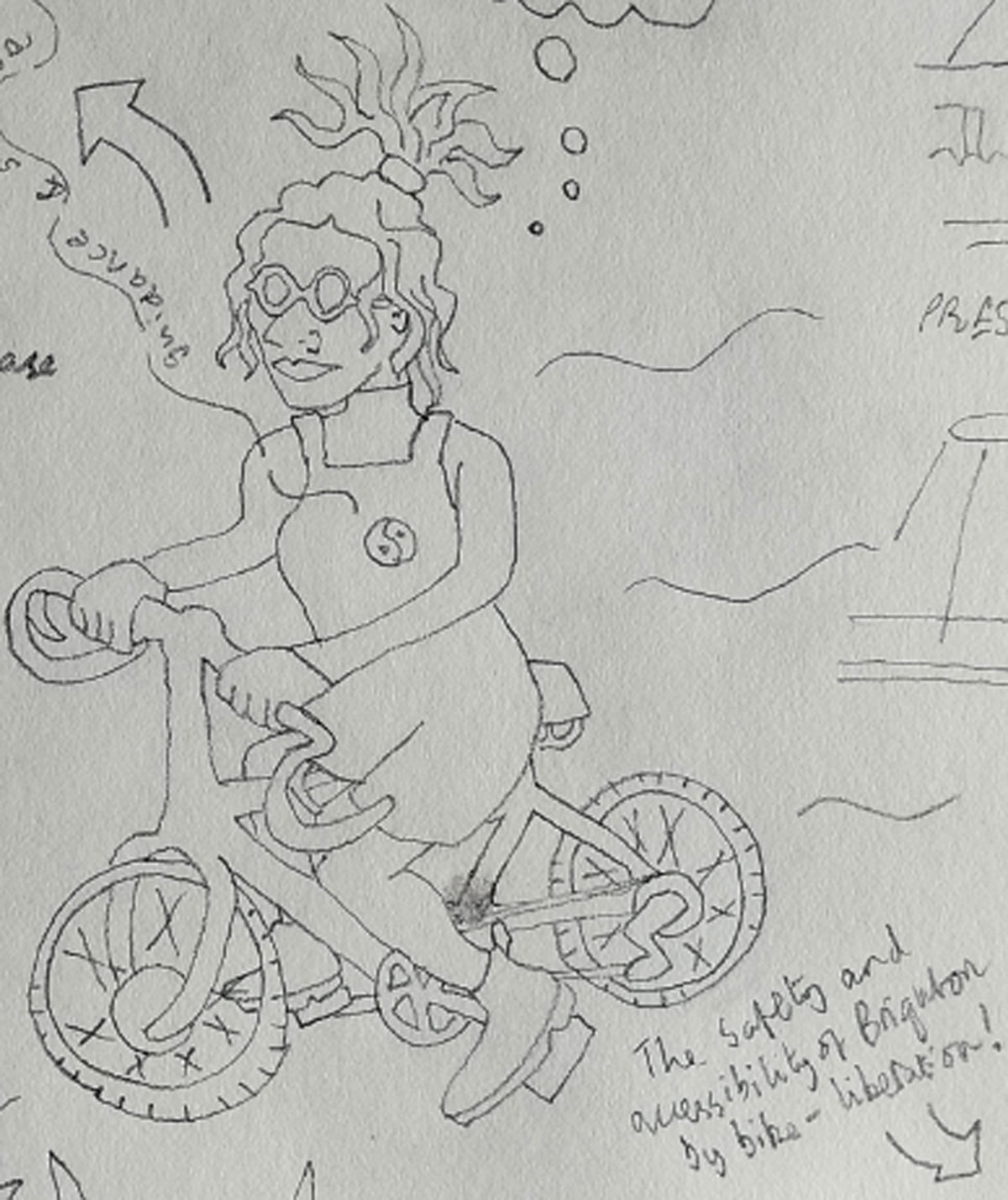
Figure 1: Extract from Lily’s body map.
Cycling acts as an infrastructure of trans care by enabling participation in community activities that increase wellbeing and facilitate a sense of belonging in the city, and by affording the embodiment of positive gender affects. This begins to shed light on how cycling can constitute mobility and motility in relation to other infrastructures while being constantly shaped by cissexism, racism, ableism and other systemic formations. To think about cycling as an infrastructure for everyday trans care brings attention to how we care for ourselves and for each other to not only survive but thrive during times marked by increasing hostility. Cycling can afford feelings of liberation due to the affirmation of the body in the moment, and because of what it enables people to attend. Cycling can be seen as an infrastructure of bodily-autonomy, that while vulnerable to traffic, can enhance independence of movement and provide a freeing feeling.
4. Transmobility as Infrastructure: Towards a research agenda
Transmobilities research has already brought attention to harassment faced on public transport and when moving through public space, and its effects on motility and movement. Expanding the range of modalities researched can help to inform policy initiatives aimed at climate change adaptations and wellbeing, such as supporting active travel within cities. It can enhance the ability of such initiatives, and policy more widely, to address the specificities of trans experiences alongside interconnected solidarities across minoritised and marginalised groups. The first component of the research agenda proposed here is therefore to ensure that the sub-field interrogates a range of transport infrastructures and initiatives within the wider sub-field.
The development of this field is crucial to understand trans people’s experiences of transport and beyond it. Mobility is key to how trans inhabitants traverse and access local and more remote queer infrastructures such as services, venues and nightlife, and is a central component in planning for more equitable trans futures. Thinking infrastructurally means situating transmobilities in their context of a myriad of social and spatial relations that sustain and constrain trans lives. It highlights the important potential of transport spaces and flows to be affirming and liberating as well as places of heightened precariousness, that shape wider health and wellbeing. The more in-depth understanding of trans people’s mobility that results from such thinking can bring into view how choices are structured and limited through the unequal provision of infrastructures of various kinds, through intersectional discrimination, and through the centrality of mobility in sustaining and enabling participation in networks of care.
Positioning mobility as one component of trans infrastructures requires that we consider the often-invisible safety strategies that trans people routinely engage in to negotiate public space. To give an example from the empirical data discussed here, when someone feels less vulnerable to harassment while cycling than while waiting at a bus stop, this implies a background experience of unsafety that is mitigated but not cancelled out by choosing the “safer” mode. At a wider, city- and regional scale, research can explore how mobility intersects with often limited, unsuitable and/or expensive housing infrastructures. The resulting pressures can displace inhabitants from safer areas, making it even harder for them to access the frequently scarce, gatekept, and suspenseful health care infrastructures that can require transnational, inter-city, and intra-city travel.
A focus on transmobilities as infrastructure should articulate a difference with policy; it should seek to avoid reiterating usage amongst already hegemonic groups through an emphasis on gender diversity. Placing these flows of care and neglect in conversation with infrastructures increases the contribution the field can make to a broader notion of mobility justice. An infrastructural lens on mobility justice requires us to address pertinent questions: does mobility policy care for a diverse range of users? Does policy create the conditions of safety and joy? Where, when and how do certain communities face harassment? How many inhabitants are inhibited by policy that only caters to the hegemonic norm, forcing them to augment their mobility? How can motility and safety of movement be enhanced that does not contribute to the displacement of the most economically vulnerable? How might we arrive at a place of trans liberation?
Future research, it is hoped, may begin to answer some of these questions. Thinking infrastructurally has implications for the methods used. For instance, the open-ended mapping process positioned mobility as one determinant of everyday health and wellbeing. As researchers, we need to engage with the politics and social relations that are in and beyond the mobility space to make equitable improvements. Research might focus on the extent to which infrastructure planning takes account of the distinctive and differential needs of trans inhabitants, which may for instance involve accessing dispersed health care services and friendship networks, whereas planning often assumes simple radial routes. Or it might explore the extent to which community initiatives, such as bike workshop sessions for queer and minoritised folk, can build knowledge and connection and contribute to a wider geography of bodily autonomy. This bodily autonomy may be supported by sustaining cycling as a mode that enables a continued “side-stepping” of spaces associated with harassment. Or research might focus on analysing the emotional components of mobility infrastructures, such as the “freeing” feeling experienced when going from a home where the neglect of a family, landlord, or housing market acts as a constraint on the flourishing of trans life, to the social events, the community top surgery fundraiser, or trans pride protest that are part of collective surviving and thriving.
Finally, future research could seek to understand how mobility is infrastructural for practices of care and resistance. How are people creating their own mobility infrastructures to counter transphobia, racism, and ableism amongst other forms of oppression? Mobility may be a means to compensate for failing formal health care infrastructure, such as the intra or international travel undertaken to access health care services, or the walk across the city to share the knowledge and hormones for forms of D-I-Y transition. Both occur in the context of a denial of care, or a failure of formal care infrastructure in the locality a person lives, whether in a timely manner or an outright denial. Research that builds upon an infrastructural approach should positively contribute to networks of care at work, such as by being a resource for the people and communities it is produced with (see Smith, Cedar and Cooper, 2025). An infrastructural approach, we believe, can assist our understanding of how mobility contributes to practices of care and neglect in the present, and has a role to play in moving us towards a more liberating destination.
Notes
- By ‘trans’ we invoke an umbrella term for identities and modes of embodiment that includes people who are transgender, non-binary, genderqueer and/or transexual amongst other terms. This is contrasted to being cisgender, where one’s gender aligns with that assigned at birth – the dominant normative position. ⮭
- https://thepansyproject.com/. ⮭
- Similar examples exist in the UK, including in Brighton where groups such as Radical Rhizomes and Trans Pride Brighton refund taxi trips for those who need them to attend specific events. ⮭
- Policing here is used in the sense of everyday reinforcement of cisgender normativities that constitute the tyranny of gender as well as institutional formations of governance that shape, inform, and enforce who belongs where. ⮭
- Source: https://landregistry.data.gov.uk/app/ukhpi/. ⮭
- She is passed, and not she is passing, is used to indicate the power resides with others to extend and retract cissexual assumption. ⮭
Competing Interests
Rachel Aldred is one of the editors of Active Travel Studies but played no part in the review process for this article. The authors have no competing interests to declare.
References
Aldred, R. and Jungnickel, K. (2014) ‘Why culture matters for transport policy: the case of cycling in the UK’, Journal of Transport Geography, 34, pp. 78–87. Available at: http://doi.org/10.1016/j.jtrangeo.2013.11.004
Aldred, R., Woodcock, J., and Goodman, A. (2016) ‘Does More Cycling Mean More Diversity in Cycling?’, Transport Reviews, 36, pp. 28–44. Available at: http://doi.org/10.1080/01441647.2015.1014451
Aversa, I., Coleman, T., Travers, R., Coulombe, S., Wilson, C., Woodford, M.R., Davis, C., Burchell, D., and Schmid, E. (2022) ‘“I’m Always Worried”: Exploring Perceptions of Safety and Community Inclusion Among Transgender People’, International Journal of Community Well-Being, 5, pp. 37–54. Available at: http://doi.org/10.1007/s42413-021-00123-9
Azzouz, A. and Catterall, P. (2021) Queering Public Space: Exploring the relationship between queer communities and public spaces, University of Westminster & ARUP. Available at: https://www.arup.com/perspectives/publications/research/section/queering-public-space (Accessed 18 February 2026).
Bain, A.L. and Podmore, J.A. (2023) ‘Rainbow infrastruggles: The infrapolitics of LGBTQ2S surplus visibility in suburban infrastructure’, Journal of Urban Affairs, 47(2), pp. 428–450. Available at: http://doi.org/10.1080/07352166.2023.2192938
Barajas, J.M. (2020) ‘Supplemental infrastructure: how community networks and immigrant identity influence cycling’, Transportation, 47, pp. 1251–1274. Available at: http://doi.org/10.1007/s11116-018-9955-7
Barras, A. (2021) ‘The lived experiences of transgender and non-binary people in everyday sport and physical exercise in the UK’, (PhD thesis). Available at: https://cris.brighton.ac.uk/ws/portalfiles/portal/31240349/BARRAS_thesis.pdf
Beebeejaun, Y. (2017) ‘Gender, urban space, and the right to everyday life’, Journal of Urban Affairs, 39(3), pp. 323–334. Available at: http://doi.org/10.1080/07352166.2016.1255526
Berlant, L. (2016) ‘The commons: Infrastructures for troubling times’, Environment and Planning D: Society and Space, 34(3), pp. 393–419. Available at: http://doi.org/10.1177/0263775816645989
Black Trans Travel Fund. (2023) About Us. Available at: https://www.blacktranstravelfund.com/about-us.html (Accessed 18 February 2026).
Boden-Stuart, Z., McGlynn, N., Smith, M.C., Jones, H., and Hirani, R. (2022) Pathways between LGBTQ migration, social isolation and distress: liberation, care and loneliness Community Report. Available at: https://mindout.org.uk/wp-content/uploads/2022/09/Pathways-between-LGBTQ-migration-social-isolation-distress-FINAL-REPORT-Sept-2022.pdf (Accessed 18 February 2026).
BBC (2018) Reality Check: How does renting a home in the UK compare? Available at: https://www.bbc.co.uk/news/uk-43075176
Brice, S. (2020) ‘Geographies of vulnerability: Mapping transindividual geometries of identity and resistance’, Transactions of the Institute of British Geographers, 45(3), 664–677. Available at: http://doi.org/10.1111/tran.12358
Brochu-Ingram, G.B. (2022). From queer ecologies to queerer infrastructure: Research methods for new designs. Guest lecture at Williams College, 1st November 2022.
Browne, K., Bakshi, L., and Lim, J. (2011) ‘“It’s Something You Just Have to Ignore”: Understanding and Addressing Contemporary Lesbian, Gay, Bisexual and Trans Safety Beyond Hate Crime Paradigms’, Journal of Social Policy, 40(4), pp. 739–756. Available at: http://doi.org/10.1017/S0047279411000250
Browne, K. and Lim, J. (2010) ‘Trans lives in the gay capital of the UK’, Gender, Place & Culture, 17(5), pp. 615–633. Available at: http://doi.org/10.1080/0966369X.2010.503118
Bull, R., Miles, C., Newbury, E., Nichols, A., Weekes, T. and Wyld, G. (2023) Hunger in the UK. Available at: https://cms.trussell.org.uk/sites/default/files/wp-assets/2023-The-Trussell-Trust-Hunger-in-the-UK-report-web-updated-10Aug23.pdf (Accessed 18 February, 2026).
Campkin, B. (2020) ‘Queer Infrastructures: LGBTQ+ Networks and Urban Governance in Global London’, in R. Ramos and S. Mowlabowcus (Eds.) Queer Sites in Global Contexts Technologies, Spaces, and Otherness (pp. 82–101). London: Routledge.
Campkin, B. and Marshall, L. (2017). LGBTQ+ cultural infrastructure in London: Night venues, 2006– present. UCL Urban Laboratory. Available at: https://www.ucl.ac.uk/bartlett/sites/bartlett/files/LGBTQ_cultural_infrastructure_in_London_nightlife_venues_2006_to_the_present.pdf (Accessed 18 February, 2026).
‘Cassie’. 2009. “No-Go for Transgendered People.” User’s comment on public RailUK Forums. July 7. Available at: https://www.railforums.co.uk/threads/no-gofor-transgendered-people.96966/ (Accessed 27 February, 2026).
Collas, S. (2019) ‘Movement’, In L. Rogue and E. Blue (Eds.) True Trans Bike Rebel (pp. 35–37). Portland, Microcosm Publishing.
Cubells, J., Aldred, R., Verlinghieri, E., and Marquet, O. (2025) ‘Walking and biking as queer: deviations, care and resistance negotiating Barcelona’s streets’, Gender, Place & Culture, 32(8), pp. 1182–1205. Available at: http://doi.org/10.1080/0966369X.2025.2469115
Doan, P.L. (2010) ‘The tyranny of gendered spaces – reflections from beyond the gender dichotomy’, Gender, Place & Culture, 17(5), pp. 635–654. Available at: http://doi.org/10.1080/0966369X.2010.503121
Dubin, S., Reisner, S., Schrimshaw, E.W., Radix, A., Khan, A., Harry-Hernandez, S., Zweig, S.A., Timmins, L., and Duncan, D.T. (2021) ‘Public Restrooms in Neighborhoods and Public Spaces: a Qualitative Study of Transgender and Nonbinary Adults in New York City’, Sexuality Research and Social Policy, 18, pp. 1002–1012. Available at: http://doi.org/10.1007/s13178-020-00504-3
Edelman, E.A. (2009) ‘The power of stealth: (In)Visible sites of female-to-mal transsexual resistance’, in E. Lewin and W.L. Leap (Eds.) Out in Public: Reinventing Lesbian/Gay Anthropology in a Globalizing World (pp. 164–179). Wiley-Blackwell.
Edelman, E.A. (2011) ‘“This Area Has Been Declared a Prostitution Free Zone”: Discursive Formations of Space, the State, and Trans “Sex Worker” Bodies’, Journal of Homosexuality, 58(6/7), pp. 848–864. Available at: http://doi.org/10.1080/00918369.2011.581928
Edelman, E.A. (2014) ‘“Walking while transgender”: Necropolitical regulations of trans feminine bodies of colour in the nation’s capital’, In J. Haritaworn, A. Kuntsman and S. Posocco (Eds.), Queer Necropolitics (pp. 172–190). Routledge.
England, E. (2022). ‘“Homelessness is a queer experience.”: utopianism and mutual aid as survival strategies for homeless trans people,’ Housing Studies, 40(7), 1545–1562. Available at: http://doi.org/10.1080/02673037.2022.2108381
Fannin, E. (2023) ‘Queering Cartographic Methods’ ATA podcast 2023:4. Active Travel Academy. Available at: https://blog.westminster.ac.uk/ata/queering-cartographic-methods/ (Accessed 12 August 2024).
Gieseking, J.J. (2022) ‘Privates: Theorizing Private Space in Trans Care’, Feminist Formations, 34(3), pp. 148–160. Available at: http://doi.org/10.1353/ff.2022.0041
Gossett, R., Stanley, E.A., and Burton, J. (2017) Trap Door: Trans Cultural Production and the Politics of Visibility. MIT Press, Cambridge, MA.
Hall, S.M. (2020) Social reproduction as social infrastructure. Soundings, 76, pp. 82–94. Available at: http://doi.org/10.3898/SOUN.76.06.2020
Hill, A. and Condon, R. (2015). ‘Brighton & Hove Trans Needs Assessment, 2015’, Brighton & Hove City Council. Available at: https://www.brighton-hove.gov.uk/files/sites/bhconnected/files/Brighton%20&%20Hove%20Trans%20Needs%20Assessment%202015.pdf (Accessed 18 February, 2026).
Kafer, A. (2013) Feminist, Queer, Crip. Bloomington: Indiana University Press.
Klinenberg, E. (2018) Palaces for the People: How To Build a More Equal and United Society. London: Bodley Head.
Krell, E.C. (2017) ‘Is Transmisogyny Killing Trans Women of Color? Black Trans Feminisms and the Exigencies of White Femininity’, TSQ, 4(2), pp. 226–242. Available at: http://doi.org/10.1215/23289252-3815033
Lam, T.F. (2018) ‘Hackney: a cycling borough for whom?’, Applied Mobilities, 3(2), pp. 115–132. Available at: http://doi.org/10.1080/23800127.2017.1305151
Lampe, T.M., Reisner, S.L., Schrimshaw, E.W., Radix, A., Mallick, R., Harry-Hernandez, S., Dubin, S., Khan, A., and Duncan, D.T. (2020), ‘Navigating stigma in neighborhoods and public spaces among transgender and nonbinary adults in New York City’, Stigma and Health, 5(4), pp. 477–487. https://psycnet.apa.org/doi/10.1037/sah0000219
Lubitow, A., Abelson, M.J., and Carpenter, E. (2020) ‘Transforming mobility justice: Gendered harassment and violence on transit’, Journal of Transport Geography, 82, 102601. Available at: http://doi.org/10.1016/j.jtrangeo.2019.102601
Lubitow, A., Carathers, J., Kelly, M., and Abelson, M. (2017) ‘Transmobilities: mobility, harassment, and violence experienced by transgender and gender nonconforming public transit riders in Portland, Oregon’, Gender, Place & Culture: A Journal of Feminist Geography, 24(10), pp. 1398–1418. Available at: http://doi.org/10.1080/0966369X.2017.1382451
Lubitow, A., Tompkins, K., and Feldman, M. (2019) ‘Sustainable Cycling For All? Race and Gender-Based Bicycling Inequalities in Portland, Oregon’, City & Community, 18(4), pp. 1181–1202. Available at: http://doi.org/10.1111/cico.12470
Lugo, A.E. (2013) ‘CicLAvia and human infrastructure in Los Angeles: ethnographic experiments in equitable bike planning’, Journal of Transport Geography, 30, pp. 202–207. Available at: http://doi.org/10.1016/j.jtrangeo.2013.04.010
Malatino, H. (2020) Trans Care, Minneapolis: University of Minnesota Press.
Malatino, H. (2022) Side Affects: On being trans and feeling bad, Minneapolis: University of Minnesota Press.
Marshall, L. (2021) ‘Negotiating gender-diverse realities built on binary expectations: Public toilets in Britain’, In J. Berry, T. Moore, N. Kalms, and G. Bawden (Eds.), Contentious cities: Design and the gendered production of space (pp. 216–233). Routledge.
Muñoz, J.E. (2009) Cruising Utopia: The Then and There of Queer Futurity. New York: NYU Press.
Nachman, J.R., Hayhurst, J.M.C. and Wang, R. (2024) ‘Bicycling for mutual aid: centering racialized and 2SLGBTQ+ cyclists in Toronto’, Urban, Planning and Transport Research, 11:1, 2277804. Available at: http://doi.org/10.1080/21650020.2023.2277804
Namaste, K. (1996) ‘Genderbashing: Sexuality, Gender, and the Regulation of Public Space’, Environment and Planning D: Society and Space, 14(2), pp. 221–240. Available at: http://doi.org/10.1068/d140221
Newhall, K. (2021) ‘“Mostly What We Do Is Ride Bikes”: A Case Study of Cycling, Subculture, and Transgender Policy’ TSQ, 8(3), pp. 349–367. Available at: http://doi.org/10.1215/23289252-9008989
Nikolaeva, A., Adey, P., Cresswell, T., Lee, J.Y., Nóvoa, A., and Temenos, C. (2019) ‘Commoning mobility: Towards a new politics of mobility transitions’, Transactions of the Institute of British Geographers, 44, pp. 346–360. Available at: http://doi.org/10.1111/tran.12287
Osei, A. and Aldred, R. (2023) ‘“You always think about what other people be thinking”: Black men and barriers to cycling in London’, Journal of Transport Geography, 108, Article 103576. Available at: http://doi.org/10.1016/j.jtrangeo.2023.103576
Pedroso, D. and Aldred, R. (2023) ‘In the opposite lane: How Women of Colour experience, negotiate and apply an oppositional gaze to dominant cycling discourses’, Perspectives, 19, Article 100828. Available at: http://doi.org/10.1016/j.trip.2023.100828
Power, E.R. and Mee, J.M. (2020) ‘Housing: an infrastructure of care’, Housing Studies, 35(3), 484–505. Available at: http://doi.org/10.1080/02673037.2019.1612038
Ritterbusch, A.E. (2016) ‘Mobilities at Gunpoint: The Geographies of (Im)mobility of Transgender Sex Workers in Colombia. Annals of the American Association of Geographers, 106(2), pp. 422–433. Available at: http://doi.org/10.1080/00045608.2015.1113112
Rodekirchen, M. and Phinney, S. (2021) ‘The Role of Social Infrastructures for Trans* People During the COVID-19 Pandemic’, in B. Doucet, B., R. van Melik and P. Filion (Eds.) Volume 1: Community and Society (pp. 223–234). Bristol: Bristol University Press. Available at: http://doi.org/10.1332/policypress/9781529218879.003.0020
Sabsay, L. (2013) ‘Citizenship in the Twilight Zone? Sex Work, the Regulation of Belonging and Sexual Democratization in Argentina’, in S. Roseneil (Ed.) Beyond Citizenship? Feminism and the Transformation of Belonging (pp. 160–183). Palgrave.
Shakibaei, S. and Vorobjovas-Pinta, O. (2022) ‘Access to Urban Leisure: Investigating Mobility Justice for Transgender and Gender Diverse People on Public Transport’, Leisure Sciences, 46(5), pp. 639–657. Available at: http://doi.org/10.1080/01490400.2021.2023372
Shuster, S.M. and Westbrook, L. (2024) ‘Reducing the Joy Deficit in Sociology: A Study of Transgender Joy’, Social Problems, 2024, 71, pp. 791–809. Available at: http://doi.org/10.1093/socpro/spac034
Simone, A.M. (2004) ‘People as Infrastructure: Intersecting Fragments in Johannesburg’, Public Culture, 16(3), pp. 407–429. Available at: http://doi.org/10.1215/08992363-16-3-407
Smith, M.C. (forthcoming) Ordinary. In Routledge Handbook of Sexualities and Space. Routledge.
Smith, M.C. (2024) Trans infrastructures: experiences of liveability in Brighton & Hove and implications for urban planning, (PhD Thesis). Available at: https://research.brighton.ac.uk/en/studentTheses/trans-infrastructures (Accessed 27 February, 2026).
Smith, M.C., Cedar, B. and Cooper, L. (2025) Under Our Own Power: A TNBI Cycling Zine. Self-published. Available at: https://blogs.brighton.ac.uk/transcycling/ (Accessed 27 February, 2026).
Smith, M.C., Gilchrist, P. and Lim, J. (2023) Planning in the “LGBTQ Capital”: Choreographing Transgender In and Out of Policy. Urban Planning, 8(2), pp. 197–207. Available at: http://doi.org/10.17645/up.v8i2.6321
Stanley, E.A. (2017) ‘Anti-Trans Optics: Recognition, Opacity, and the Image of Force’, South Atlantic Quarterly, 116(3), pp. 612–620. Available at: http://doi.org/10.1215/00382876-3961732
Todd, J.D. (2021) ‘Exploring trans people’s lives in Britain, trans studies, geography and beyond: A review of research progress’, Geography Compass, 15(4): e12556. Available at: http://doi.org/10.1111/gec3.12556
Todd, J.D. (2023a) ‘Intervention — “Trans Liberation in the UK is Under Threat: How Geographers Can Respond”’, Antipode Online. Available at: https://antipodeonline.org/2023/05/24/intervention-trans-liberation-in-the-uk/
Todd, J.D. (2023b) ‘Exhaustion, Exhausting Temporalities, and Young Trans People’s Everyday Lives in the UK’, Annals of the American Association of Geographers, 113(3), pp. 771–789. Available at: http://doi.org/10.1080/24694452.2022.2134087
Turesky, M. and Crisman, J.J. (2023) ‘50 Years of Pride: Queer Spatial Joy as Radical Planning Praxis’, Urban Planning, 8(2), pp. 262–276. Available at: http://doi.org/10.17645/up.v8i2.6373
Valentine, G. (1989) Women’s fear of male violence in public space: a spatial expression of patriarchy, (PhD Thesis). Available at: https://ethos.bl.uk/OrderDetails.do?uin=uk.bl.ethos.236852 (Accessed 18 February, 2026).
Weintrob, A., Hansell, L., Zebracki, M., Barnard, Y., and Lucas, K. (2021) ‘Queer mobilities: critical LGBTQ perspectives of public transport spaces’, Mobilities, 16(5), pp. 775–791. Available at: http://doi.org/10.1080/17450101.2021.1958249
Wilson, A. (2016) ‘The Infrastructure of Intimacy’, Signs, 41(2), pp. 247–280. Available at: http://doi.org/10.1086/682919
Xie, L. and Spinney, J. (2018) ‘“I won’t cycle on a route like this; I don’t think I fully understood what isolation meant”: A critical evaluation of the safety principles in Cycling Level of Service (CLoS) tools from a gender perspective’, Travel Behaviour and Society, 13, pp. 197–213. Available at: http://doi.org/10.1016/j.tbs.2018.07.002