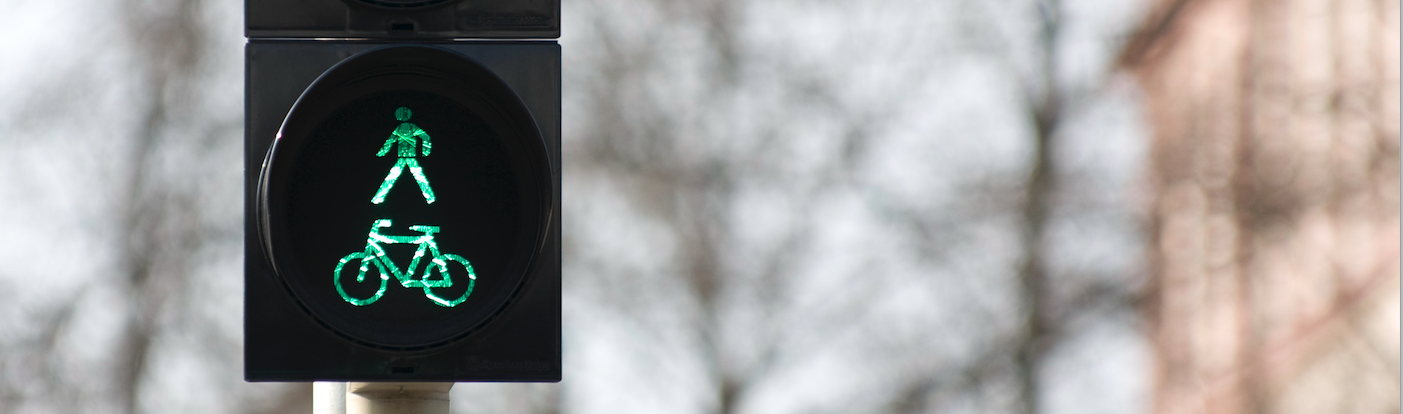
My bike is as much a way for me to get around as it is an entry point for talking about disability. I started riding a bike as an adult when I could still walk without constant pain. As walking became more painful, I biked more. It wasn’t a conscious decision at first; it just made sense to choose to cycle based on the needs I had.
Now, 15 years after I started cycling as an adult, after one joint fusion in my foot, a recent ankle replacement, and another ankle living on borrowed time, my bike and my trike are my main mobility aids.
I don’t know the moment it happened; it must’ve been a slow realization. ‘My bike is my mobility aid’, I started saying. I’m disabled, I realized, and I need a mobility aid. I felt fortunate that I had already discovered the accessibility hack of cycling. I joined the board of the local cycling advocacy group and sometimes shared my lived experience to help advocate for infrastructure and against ableist approaches (e.g., ‘cyclists dismount’ signs at trail crossings).
Because ableism afflicts us all, I hadn’t reckoned with my status as a disabled person until my 30s, even though my disability started at 14 months old. I never even entertained the label or the identity. Disability was something to be pitied, to be avoided, or to overcome.
But when I was invited to speak at a student urban planning conference on the topic of accessibility and cycling, I wanted to broaden out from my own experience. So, I started to research disability and its different models. I found Alice Wong, Sins Invalid, and so many others. I began to understand that the identity I had tried to ignore and to avoid is one that connects me to an entire community. A community of crip elders who believe in the tenets of disability justice, leaving no one behind, and navigating access friction together.
There’s a tension, though, in using a mobility aid that is not only outside of the norm but is quite widely understood as something that is used exclusively by able-bodied folks. I feel the need to prove my disability, and I am mindful of how I appear to the outside world. As I cross paths with an older woman using a rollator, I take extra care in passing her and I want to explain, ‘You see, I’m disabled, too. I am part of your community.’ I also imagine what non-disabled people in my community think about me: ‘She’s not really disabled; she rides a bike.’ In fact, people on Twitter have told me this.
These thoughts – this need to defend myself – come from internalized ableism. I, like most others, grew up with a narrow understanding of the lives of disabled people. I still have to tell myself that I belong in disabled community and that my preferred mobility aid does not revoke my identity as ‘disabled’.
However, I wrestle with the fact that cycling infrastructure is adapting faster than the environment needed by my disabled friends who do not cycle. As much as cyclists often feel like second-class citizens who must beg for infrastructure, the non-disabled cyclists usually do not realise that their disabled neighbours are working even harder, with fewer spoons, for the most basic of affordances in the built environment. I hear complaints from faster cyclists who are annoyed by multiuse paths because they must dodge pedestrians; however, for folks with guide dogs or white canes, these paths are an actual safety hazard that can hinder their ability to navigate city streets. A blind friend noted that she had been asking for a marked crosswalk for a busy street for years, but it was only when new cycling infrastructure was planned in the area that the crosswalk was also added.
I have decided to make the best of this tension I experience in being a disabled person who uses an unconventional mobility aid. I do two things: One, when I have a chance to critically evaluate plans for infrastructure in my city, I start with focusing on the needs of disabled people who do not cycle. I ask about accessible parking, tactile warning strip placement, and more. I am motivated by disability justice and the need for cross-disability solidarity. It is exhausting to repeat the same concerns to planners and engineers for every single project, but I refuse to let them continue to design my city in ways that erase my disabled community. Two, I use the platform I have through co-organizing Kidical Mass. These rides are a wonderful opportunity for intergenerational learning. I know the children sometimes notice aspects of my disability, whether it’s the portable chair I use at the start and end points of the ride, or a wrist splint I might wear. I answer their questions, and we include children’s books about disability in our recommended reading list.
Although my overall goal is to help my cycling community expand their conception of disability, it is always on my mind that the children at Kidical Mass rides may need disabled role models. I hope that I am helping the children whom I get to know on these rides to grow up with a more nuanced understanding of disability, because they see me as part of their community. It’s also very personal for me because, as a disabled child, I didn’t know any disabled people and I think of what a difference it might have made in my understanding of my own identity if I had.
That cycling enables my mobility is, perhaps, not surprising. What is remarkable and worth celebrating is that cycling has enabled me to embrace an important part of my identity, connect with the broader disability community, and become an advocate for active transportation that better meets everyone’s needs.
Competing Interests
The author has no competing interests to declare.