
1. Introduction
Grampian Inclusive Cycling Bothies1 (GICB) is a three-year funded project with the ambition of making cycling more accessible for communities across the North East of Scotland. The project covers the local authority areas of Aberdeen City and Aberdeenshire Councils, which have a combined population of 492,070 (National Records of Scotland 2024). Data available from Scotland’s Census 2022 shows that 245,725 individuals in the region report having a long-term health condition or disability2 (Scotland’s Census 2024). It is recognised that everyone is unique in terms of their ability and confidence to take part in cycle-based activities, and no single approach will meet all needs and aspirations.
The bothies are physical locations where non-standard cycles are made available to members of the public, supported by volunteers. In this context, the term “bothy” is used to loosely denote a cycle hub at a defined location that is open to all. The most frequent embodiment of a “bothy” for GICB is simply a storage container next to a piece of flat, traffic free infrastructure that is open to all. The bothies are then brought to life through the experiences of the participants and volunteers in creating accessible opportunities for leisure cycling in the North East of Scotland. The primary objective of the project is to locate bothies within communities to help erase barriers to cycling. Therefore, the underpinning premise of GICB is that by having cycles stored at bothies throughout the region, this enables non-standard cycles to be brought closer to the people in communities who want to use them.
A core focus of the project is also to promote health, wellbeing, and the environmental benefits of cycling in an inclusive way across communities in the region. Following Larrington-Spencer (2025), I have approached this work with the belief that there are benefits of integrating physical activity into forms of mobility for disabled people, but that this needs to be mediated by a more inclusive understanding of physical activity and emphasis on making active travel for disabled people a lived reality.
Finally, a brief note on the language used in this piece of work. Firstly, following Inckle (2019), for reasons of inclusivity, throughout this work I will use the term “cycle” when referring to non-standard cycles. Secondly, Andrews, Powell, and Ayers (2022) describe the need for engaging in an informed choice of disability language in academic publications and it should be noted that the language used in this article adheres to the social model of disability which exists within the UK. This way of viewing the world says that people are disabled not by their impairment or condition, but rather by barriers constructed by society (Scope, no date). While I recognise the imperfections in the social model of disability (e.g., Inckle 2019), in framing this article through the lens of the social model I endeavour to avoid the stigmatising effect of language and seek to use the preferred terminology of disabled people in the context of this UK-based project.
2. Policy Context: The Evolution of People & Place
Transport is one of the devolved areas of policy under the remit of the Scottish Parliament and Scottish Government.3 Transport policy in Scotland is administered through a process of multi-layered governance, with funding disbursed by Transport Scotland and administered through these various government layers. Transport Scotland is the national transport agency for Scotland and is an executive agency of the Scottish Government. It has the aim of delivering, “…a sustainable, inclusive, safe and accessible transport system” (Transport Scotland 2020, p.5).
Transport Scotland is also responsible for the funding of walking, wheeling, and cycling, and behaviour change projects in Scotland. Since 2024, behaviour change is delivered through the People and Place Programme, administered by RTPs, and delivered by a broad range of partner organisations in the public and third sectors. From an infrastructure perspective, this is supported through the Active Travel Infrastructure Fund, and at local authority level through their own funding. There are other nuances to the administration of funds for active and sustainable travel, but I do not intend to explore these in the context of this paper as they do not directly impact on the GICB project.
Regional Transport Partnerships (RTPs) represent the second layer of governance. In total there are seven RTPs in Scotland, with Nestrans being the relevant RTP for the North East of Scotland. The stated role of RTPs is to “strengthen the planning and delivery of regional transport developments” (Transport Scotland 2022). RTPs were established by the Transport (Scotland) Act 2005 to help prevent competition between local authorities for investment, and the detriment this represents (Docherty, Shaw, and Gray 2010, p. 145). However, RTPs require the cooperation of both Transport Scotland and their local authority partners, creating a perception that RTPs are “weak” (Pangbourne 2010, cited in Marsden and Docherty 2019, p.57). However, the changes brought by the Transport (Scotland) Act 2019 and the Verity House agreement have significantly strengthened the role of RTPs in this multi-layered governance landscape. Each RTP is tasked with developing a Regional Transport Strategy, and through its RTS, Nestrans has a stated commitment to ensuring accessibility for all (Nestrans 2021, p. 23).
The third layer of governance is delivered by Scotland’s thirty-two local authorities, each of whom are connected with a relevant RTP. From a policy perspective, there is reliance on local authorities to be at the core of policy implementation in relation to active travel (Bloyce and White 2018, p. 17) and they remain key delivery partners under the new People and Place arrangements. In the North East of Scotland, the relevant local authorities for the Nestrans area are Aberdeen City Council and Aberdeenshire Council.
As of 2024/25, Transport Scotland introduced a new model for behaviour change interventions as part of its active travel transformation programme (Transport Scotland 2024). This model sees funding channelled directly to Scotland’s seven Regional Transport Partnerships, who then work with their local authorities and other delivery partners to “identify and focus on the priorities in their area, and to build capacity at a local level” (Transport Scotland 2024). Prior to this, funding had generally been administered via a model that focussed on national charities such as Sustrans Scotland and Cycling Scotland (see Hood 2024). By adopting this model, Transport Scotland hopes to make active travel more accessible, noting the health and economic benefits associated with such modes (Transport Scotland 2024).
The programme has four key themes, as set out below in Table 1. The intention behind these themes is to “maximise the return on investment” and to ensure alignment with National Transport Strategy 2, the Active Travel Outcomes Framework, and First Minister’s priorities for Scotland (Transport Scotland 2024).
Summary of Outcomes & Themes.
| Schools and Young People | Interventions in and around schools that deliver holistic solutions for creating an environment where active travel choices are not only an option, but the most desirable way to travel for young people and families |
| Workplaces | Interventions that focus on places of work (including larger employers and trip generators) and which make active travel choices a realistic option for commuting |
| Accessibility and Inclusion | Interventions that improve and promote accessibility and inclusion and create opportunities for everyone to be able to make the choice to travel actively |
| Capacity and Capability Building | Interventions that build the delivery capacity and capability of the active travel sector (including RTPs, LAs, and third sector delivery partners) |
The consequence of this shift to more localised delivery, saw each of Scotland’s RTPs being given direct funding by Transport Scotland to administer to local delivery partners. For the Nestrans region, this amounted to funding of £1,737,667 being spent across active travel projects in Aberdeen City and Aberdeenshire. Nestrans mirrored the project themes set out in Table 1, with the ambition of maximising opportunities to increase modal shift across communities in the North East of Scotland. In 2024/25, Nestrans funded thirteen projects from the outset, with three additional projects onboarded during the year. Each of these projects contributed to achieving the outcomes set out in Table 1.4
The GICB project aligns with three of the four People and Place themes, achieving outcomes for Schools and Young People, Accessibility, and Inclusion, and supporting Capacity and Capability Building. More information on the format and delivery of the GICB programme is provided in Section 3.
3. Inclusive Cycling in NE Scotland
Presently, GICB operates across four core locations – Aberdeen, Peterhead, Alford, and Banff – running regular sessions at traffic free, flat locations using accessible cycles. This core offer is also augmented by guided off-road cycles in Ballater. From an organisational perspective, the initiative originally received funding through National Lottery Community Fund to develop and deliver a programme across Aberdeen City and Aberdeenshire. The funding received from Nestrans’ People & Place programme in 2024/25 has allowed expansion of provision from two to four main venues, and recruitment of further staff members. The sessions are free and open to all ages and abilities and are supported by a team of staff and volunteers. The funding secured by Sport Aberdeen through the Nestrans People & Place funding has enabled the project to double its programme footprint, as well as supporting a range of additional requests at schools and other locations across the region.
Sport Aberdeen hosts the programme on behalf of Grampian Disability Sport (a volunteer run charity), collaborating with other key partners such as Scottish Disability Sport, Live Life Aberdeenshire, and Scottish and British Cycling. However, there is a risk that the reliance on sports focussed organisations and locations to support such events potentially presents both a perceptual and practical barrier to transitioning from leisure-based cycling to utility cycling for participants. While expanding participation, the session-based nature of the activities does not replicate conditions for independent travel. While not all participants may aspire to independent utility cycling, and so embrace the wider aspirations of active travel, the capacity and capability should exist to support and encourage those who do.
Effective bike share or bike loan schemes could also function as a catalyst to widening participation in everyday cycling by disabled people. Research undertaken by Cycling UK in 2021 on behalf of Transport Scotland found that 62% of respondents expressed an interest in non-standard bike5 share or loan scheme, however, cost and lack of suitable infrastructure were noted as key barriers to the use of cycles for disabled people (Cycling UK 2021). Overall, the emphasis on leisure cycling and the absence of infrastructure combine to preclude many disabled people from choosing cycling for everyday journeys and bridge that transition from leisure cycling to utility cycling.
At present the sessions are delivered across 5 locations spanning Aberdeen City and neighbouring Aberdeenshire. An overview of how and where the GICB model operates is provided in Table 2.
Summary of GICB Locations, Formats, and Participation Levels for 2024/25.
| Bothy Location | Session Format | Number of Participants6 |
| Aberdeen Cycle Hub at Seaton | Bi-weekly sessions | 139 |
| Catto Park Athletics Track, Peterhead | Weekly sessions | 42 |
| Deveron Community and Sports Centre, Banff | Sessions delivered depending on demand and volunteer capacity. A total of 5 distinct sessions delivered in 2024/25 | 19 |
| Grampian Transport Museum, Alford | Sessions delivered depending on demand and volunteer capacity. A total of 8 distinct sessions were delivered in 2024/25 | 36 |
| Ballater (off-road) | Guided off-road rides. Monthly sessions in Spring/Summer with a total of 4 sessions delivered in 2024/26 | 8 |
As noted above, all locations are traffic free and, apart from Ballater, are flat. Participants are invited to sign up to sessions using Eventbrite, however the weekly sessions in Peterhead operate on a drop-in basis. All sessions are led by qualified ride leaders and offer a range of cycles to suit participant preferences and capabilities. A range of training has been provided to volunteers, including first aid, Ride Leader, and Bikeability7 training. However, it is acknowledged that there is a limited pool of resources for cycling instructors that consider the needs of disabled people (Berent, Fujiyama, and Yoshida 2021).
As part of the overall project evaluation process for the Nestrans People & Place Programme, Sport Aberdeen gathered feedback that provides insight into the impact of the GICB sessions for the individuals who attend the sessions. For the Aulton Bothy, most participants have been young people under the age of18 and adults in the 18–24 age group, whereas the other bothy locations have a wider age range of participants. Due to the small numbers present at other locations, more specific demographic information has not been included.
In 2024/25 the GICB project also serviced requests from Mintlaw, Meldrum and Laurencekirk Schools who all borrowed inclusive bikes to allow disabled pupils to undertake Bikeability training. Provision has also been supported at specific ASN school locations including St Andrews Primary School (Inverurie) and Carronhill School (Stonehaven). In addition to delivery of sessions in educational settings, there is also a Bike Library based at the Garioch Centre, Inverurie which has enabled staff to take bikes to a variety of locations. These include Love to Ride Climate Week, Live Life Aberdeenshire Summer of Play, NHS Wellbeing Festival, and Banff Family Support Group.
For the core bothy locations, key findings from the evaluation document for the GICB 2024/25 programme are set out below, grouped thematically in Figure 1 to explore the impacts and barriers associated with the programme model.
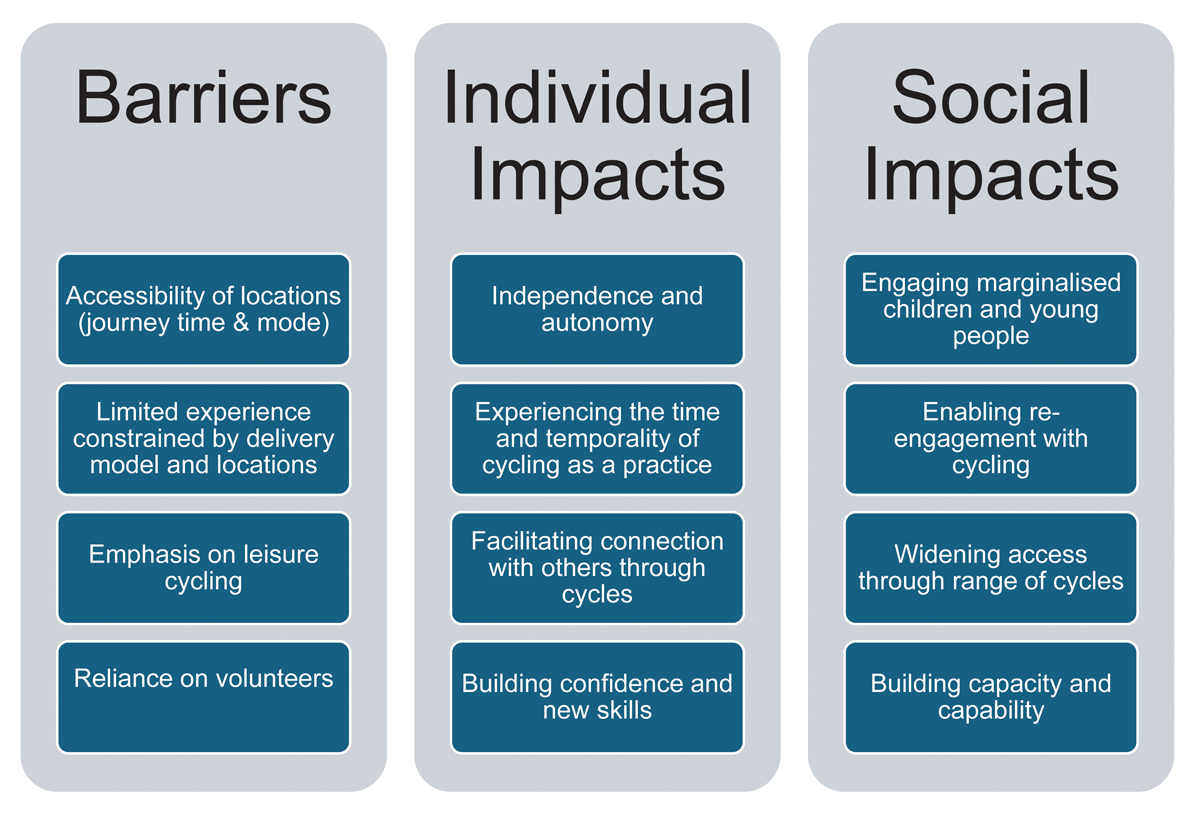
Overview of impacts and barriers.
As noted in Figure 1, there are identified practical impediments that function as barriers for participants. These range from the accessibility of the locations, with one participant taking three buses to access the Alford session, to the constraints presented by the dominance of leisure cycling as the underpinning ethos. However, there are many important social and individual impacts associated with the GICB sessions that are best understood through the data gathered from the 2024/25 project evaluation data.
Reflecting on individual impacts, there is a clear embodiment of joy conveyed by session participants. For example, a participant at a session in Ballater said,
“Thank you so much for a wonderful morning! I thoroughly enjoyed it. Really appreciate you organising these trips and I’m looking forward to doing it again sometime” (Participant at Ballater Session)
Also evident in the data gathered from participants is an overwhelming sense of freedom from being able to cycle. For example, at Seaton Primary School in Aberdeen, GICB made it possible for a handcycle to be taken to the school to enable a disabled young person to take part in a Bikeability session. In the project evaluation report, it was noted that,
“When he got on the bike for the first time he said, ‘I’m free’ and absolutely loved cycling around the playground. The Pupil Support Assistant said he isn’t very chatty but by the end of the three sessions, he completely came out of his shell and was asking lots of questions” (Sport Aberdeen Employee).
Similarly, another participant also reflected on this sense of freedom and how meaningful this became as part of the session experience,
“Just to say thank you so much to you and your colleagues for your time, patience, and help today. It’s the first time that I have felt a sense of freedom for a long time…years in fact” (Participant at Aberdeen Session)
It is also evident that the breadth of cycle provision enables a depth of participation that is significant. An individual at the Alford session was able to make use of a recumbent trike, which allowed them to rediscover cycling having previously given up horse riding and mountain biking due to a neurological condition. Equally, a young person, previously unable to take part in family cycling activities due to lack of a suitable bike, attended three of the Ballater rides and for the first time he was able to cycle with his mother, father, and sister.
At each of the bothy locations, positive feedback has been gathered from staff, volunteers, and participants demonstrating a demand for the sessions. There is also a broader theme of building capacity and capability in supporting volunteers to deliver these sessions, which can function as an important route to facilitating wider participating in utility cycling for disabled people. However, without further funding and investment in supporting capacity and capacity for delivery of utility cycling focussed solutions, there is a risk that the GICB model will remain constrained by its leisure cycling origins. The sport focus of many of the locations and the delivery model also risks shaping perceptions around cycling and indeed who utility cycling is for in society, risking the further marginalisation of disabled people within active travel.
However, the impact on young people, particularly those for whom traditionally structure school lessons present a barrier, is particularly encouraging. More broadly, from the quotes gathered from participants, there is a sense of freedom and joy associated with the act of cycling. While it is possible to analyse these experiences as outcomes through a lens of existing health and transport policy, there is also the freedom to interpret these experiences through the lens of space, time, and temporality and how these relate to the practice of cycling (Hood 2024). As my colleague frequently reminds the Nestrans team, “it’s not just about bikes,” or in this case, cycles.
4. Assessing the Impacts & Lessons Learned
It is evident from the experience of those delivering the GICB programme that to maximize participation, ensuring access to a safe riding venue and the ability to securely store a variety of bikes in each location are critical factors. Further, due to the size of non-standard cycles, Sport Aberdeen has reported challenges in identifying suitable venues for storage. This holds much in common with Larrington-Spencer’s (2025) autoethnographic work on her experiences as a disabled tricyclist, which captures the practical barriers encountered by disabled people in pursuing active forms of mobility. Similarly to work undertaken by Inckle (2019), where the gap between policy and the experience of disabled people cycling is identified, the experiences of those participating in GICB sessions is echoed. Reflecting on the gap between policy and reality within the context of Transport Scotland’s aspirations for the People and Place programme, what the GICB project has highlighted is the importance of ensuring the accessibility of traffic-free routes for disabled people to and this is a key lesson learned from the project that must find a way of being integrated into wider policy considerations that the accessibility of infrastructure is a critical consideration.
Also connected with infrastructure provision noted by GICB is the identified tension between pursuing accessibility for all and place policies that seek to mediate access to traffic-free routes on grounds of safety (Larrington-Spencer 2025), and this is no different in Scotland. Looking to the future, these challenges evidence the need for a more nuanced understanding of the lives and aspirations of disabled people, and the requirement to integrate the social model of disability more fully into active and sustainable travel policies and programmes. While some of the infrastructure barriers encountered by disabled people who cycle will share commonalities with other user groups, as noted by Cox and Bartle (2020), these have a significant and limiting impact for disabled people. In short, we still have some way to go in achieving equity for disabled people in supporting access to cycles and cycling, which can only support broader policy aspirations across health, transport, and the social inclusion of disabled people (Mosser, Norcliffe, and Kruse 2025).
Indeed, if we are to truly achieve the aspirations of creating opportunities for everyone to be able to make the choice to travel actively or participate in cycle-based physical activity, further capital investment is required in enhancing infrastructure and expanding access to cycles for all. However, there is also benefit in developing bespoke inclusive cycle training resources that mirror the wealth of resources available for non-disabled people (Berent, Fujiyama, and Yoshida 2021) to support provision.
In re-evaluating the funding model for behaviour change programmes in Scotland, Transport Scotland has enabled RTPs to direct funding to local organisations, achieving a more equitable allocation of funds across Scotland. It has given RTPs autonomy in the decision-making process, while ensuring a structured approach to achieving outcomes through the creation of four core themes (Table 1). This has allowed for existing partnerships to be built upon, ensuring that funding is directed to where it is most needed and, critically, avoided duplication of effort. In summary, it has enabled local delivery partners to be on an even footing with large national delivery partners when it comes to applying for funding. This is an important development in ensuring local solutions for communities.
For example, the funding awarded to GICB through the Nestrans People and Place programme has facilitated the investment of capital to purchase of seven more cycles, taking the total fleet to forty-eight cycles across the four bothy locations. Of significance is also the provision of funding to expand the number of staff employed and therefore capable of delivering the project. Although Peterhead has a core group of established volunteers, all other hubs rely on staff support to ensure regular sessions are supported, emphasizing the crucial role that funding plays in facilitating the programme’s long-term sustainability. Yet, there is also an unspoken level of precarity associated with projects funded through the People and Place programme. While there is ring-fenced funding for active and sustainable travel programmes in Scotland, the grant of funding is made annually, and must be spent within the same financial year. There is no guarantee of funding, and in the Nestrans area, delivery partners are required to re-apply to the fund annually through a competitive tender process.
These challenges are not new, and funding remains a key factor for public sector service delivery for active travel in Scotland (Hood 2024). For delivery partners, the award of multi-year funding grants security of tenure for their staff and the ability to plan multi-year delivery programmes. From Transport Scotland’s perspective, officials are aware of the clear benefits of multi-year funding, but it is tacit knowledge that this cannot be realised within the current funding structure and constraints under which the Scottish Government operates. Achieving parity across transport requires a systems level re-think on how funding is allocated if we are serious about closing the gap between policy aspiration and delivery.
5. Conclusions
In this work, I have sought to take the reader through a tour of the GICB project from its origins and funding streams, through to its participants and deliverers. In doing so, I hope to have contributed to the limited body of knowledge on disabled people who cycle, increasing visibility for disabled people within the leisure sphere and showing how policy and targeted funding can be an enabler for marginalised groups in communities. In reviewing the impacts of the project, there is the immediate impact of extending the joy of movement of cycling to disabled people who may not have experienced this and being able to do so in a safe and supportive environment. However, there are also the wider co-benefits of spotlighting the potential socio-cultural and policy benefits of thinking inclusively about cycling and cycles.
The revision to the funding model in Scotland, which I have previously critiqued (Hood 2024) is a welcome change to fulfil the promise of the Verity House Agreement and its ethos of local by default, national by agreement. Through GICB we have been afforded the opportunity of seeing a different and more inclusive approach to mobility; one that prioritises the needs of marginalised groups and seeks to offer a mobile future that embraces equity and not just equality of opportunity. To truly achieve parity for disabled people, future initiatives must seek to enable the integration of cycling into the daily lives of disabled people through the facilitation of utility cycling and not only leisure cycling opportunities.
Notes
- Bothies are part of Scotland’s outdoor culture and are defined by the Mountain Bothies Association as simple shelters for the use of all – https://www.mountainbothies.org.uk/. ⮭
- This data sets combines the Census data from the following categories: (i) deaf or partially hearing impaired; (ii) blind or partially vision impaired; (iii) full/partial loss of voice or difficulty speaking; (iv) has one or more learning disability, learning difficulty or developmental disorder; (v) physical disability; (vi) mental health condition; and (vii) long-term illness, disease or condition. They are taken collectively to avoid labelling any one group of individuals. ⮭
- Subject to the exceptions defined in Schedule 5, Scotland Act 1998. ⮭
- See further – https://www.nestrans.org.uk/projects/people-and-place/. ⮭
- This is the terminology used by Cycling UK. ⮭
- These are noted as distinct participants, with many individuals returning on a regular basis. ⮭
- Bikeability is the national cycle training programme for school children. It is delivered by Cycling Scotland in partnership with Scotland’s thirty-two local authorities. ⮭
Acknowledgements
The author wishes to acknowledge the ongoing work of Mark Pain (Sport Aberdeen) and his team in the delivery of GICB and the Nestrans People & Place Programme.
The author also acknowledges Transport Scotland as funder of the 2024/25 Nestrans People & Place Programme.
Competing Interests
The author is an employee of Nestrans, the Regional Transport Partnership for North East Scotland, who receives grant funding from the Scottish Government and administers these funds through a competitive process to organisations including Sport Aberdeen.
References
Andrews, E.E., Powell, R.M. and Ayers, K. (2022). ‘The evolution of disability language: choosing terms to describe disability’, Disability and Health Journal, 15(3), 101328. Available at: http://doi.org/10.1016/j.dhjo.2022.101328
Berent, P.A., Fujiyama, T. and Yoshida, N. (2021). ‘Evaluating delivery of cycling activity and training programmes for disabled people in the UK’, IATSS Research, 45(3), pp. 371–381. Available at: http://doi.org/10.1016/j.iatssr.2021.03.006
Cox, B. and Bartle, C. (2020). ‘A qualitative study of the accessibility of a typical UK town cycle network to disabled cyclists’, Journal of Transport and Health, 19, 100954. Available at: http://doi.org/10.1016/j.jth.2020.100954
Cycling UK. (2021). Adaptive bike share survey: results 2021. December. Available at: https://www.cyclinguk.org/sites/default/files/document/2021/12/adaptive_bike_share_survey_results_2021_-_cycling_uk.pdf (accessed 13 October 2025).
Docherty, I., Shaw, J. and Gray, D. (2010). ‘Transport strategy in Scotland since devolution’, Public Money & Management, 27(2), pp. 141–148. Available at: http://doi.org/10.1111/j.1467-9302.2007.00570.x
Hood, C.M. (2024). Mind the gap: an evaluation of the organisational, practical, and social influences on the implementation of cycling specific policies in Aberdeen. Available at: http://doi.org/10.48526/rgu-wt-2795651 (Accessed 5 June 2025).
Inckle, K. (2019). ‘Disabled cyclists and the deficit model of disability’, Disability Studies Quarterly, 39(4). Available at: http://doi.org/10.18061/dsq.v39i4.6513
Larrington-Spencer, H. (2025). ‘Autoethnography of disability and active travel in Greater Manchester: encountering (non)citizenship through access controls on traffic-free walking, wheeling, and cycling paths,’ Urban Studies. Available at: http://doi.org/10.1177/00420980241311728
Marsden, G. and Docherty, I. (2019). Governance of UK transport infrastructures. Future of mobility: evidence review, January. Available at: https://assets.publishing.service.gov.uk/government/uploads/system/uploads/attachment_data/file/780871/governance.pdf (Accessed 5 June 2025).
Mosser, N., Norcliffe, G. and Kruse, A. (2025). ‘The impact of cycling on the physical and mental health, and quality of life of people with disabilities: a scoping review’, Frontiers in Sports and Active Living, 6. Available at: http://doi.org/10.3389/fspor.2024.1487117
National Records of Scotland (2024). Mid-2023 population estimates, 8 October. Available at: https://www.nrscotland.gov.uk/publications/mid-2023-population-estimates/ (Accessed 5 June 2025).
Nestrans (2021). Regional Transport Strategy for the North East of Scotland, November. Available at: https://www.nestrans.org.uk/wp-content/uploads/2021/12/Nestrans-RTS_PUBLISHED.pdf (Accessed 5 May 2025).
Scope (no date). Social model of disability. Available at: https://www.scope.org.uk/social-model-of-disability (Accessed 5 June 2025).
Scotland’s Census (2024). Scotland’s Census 2022 – health, disability and unpaid care, October 2024. Available at: https://www.scotlandscensus.gov.uk/2022-results/scotland-s-census-2022-health-disability-and-unpaid-care/ (Accessed 5 June 2025).
Transport Scotland (2020). National Transport Strategy 2, 5 February. Available at: https://www.transport.gov.scot/publication/national-transport-strategy-2/ (Accessed 5 June 2025).
Transport Scotland (2022). Regional Transport Partnerships. Available at: https://www.transport.gov.scot/our-approach/strategy/regional-transport-partnerships/ (Accessed 5 June 2025).
Transport Scotland (2024). Behaviour change. Available at: https://www.transport.gov.scot/active-travel/behaviour-change/ (Accessed 5 June 2026).