
1 Introduction
Anthropogenic climate change is unequivocal, and sustained emissions reduction is needed (Oreskes, 2004). Yet concerted efforts remain in public conversation to minimise evidence and negate the need for action (Roper, Ganesh and Zorn, 2016). Lamb et al (2020) identify four strategic forms of such negation: (1) denial of (anthropogenic) climate change, (2) climate impact scepticism, (3) ad hominem attacks on scientists and consensus, and (4) discourses of climate delay. As yet, there is little exploration of discourses of delay—defined by Lamb et al (2020:1) as “policy-focused discourses that exploit contemporary discussions on what action should be taken, how fast, who bears responsibility and where costs and benefits should be allocated”.
We use Low Traffic Neighbourhoods (LTNs) as a case study to explore how discourses of climate delay are produced within everyday accounts of climate mitigation. LTNs seek (among other goals) to reduce carbon emissions by cutting car use. Within an LTN (typically a contiguous set of residential streets), bollards or cameras are used to restrict motorised through-traffic (Figure 1). Homes within the LTN remain accessible by motor vehicle; however, the journey is often more circuitous. As such, LTNs aim to induce a shift from private motor vehicles to active modes through two pathways: first, less convenient car journeys and second, more pleasant environments for active travel (Laverty, Goodman and Aldred, 2021).
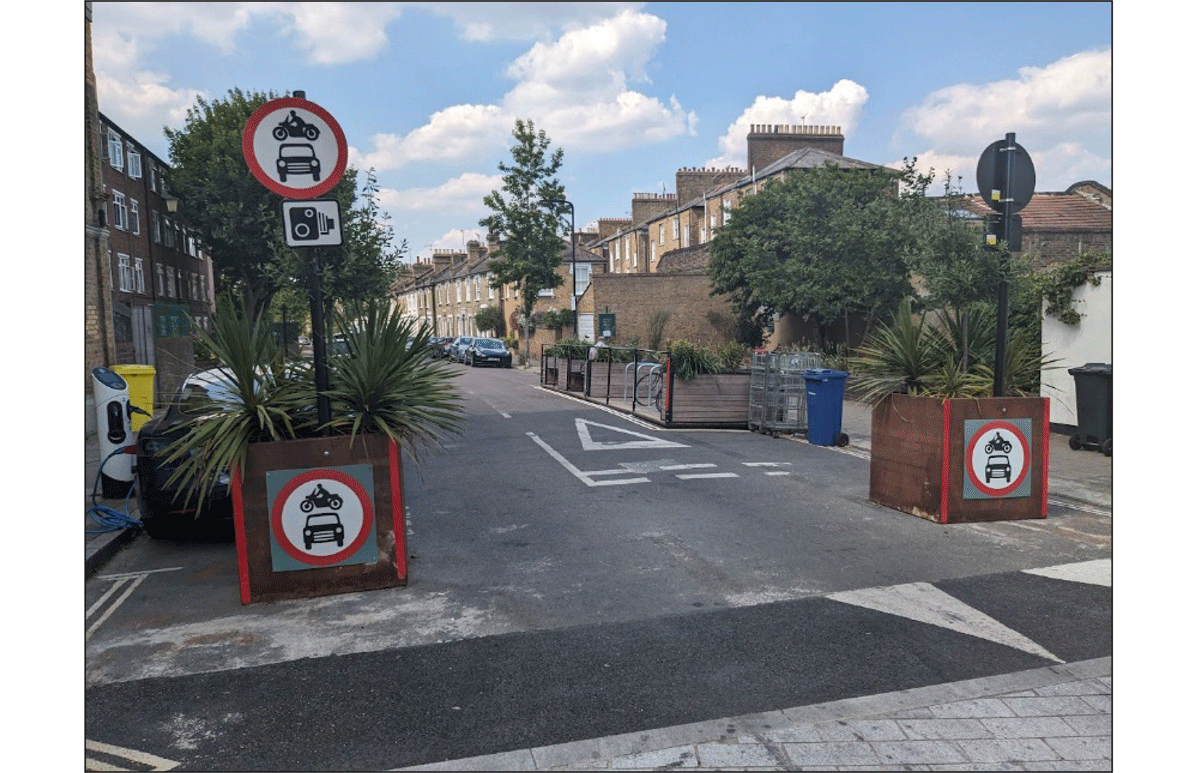
Automatic Number Plate Recognition (ANPR) enforced modal filter in a case study LTN. (A residential street where there are two planters on either side of the road with road signs that indicate there is no access for motor vehicles and that this is enforced using cameras.)
LTNs sit within a wider suite of transport planning measures aimed at reducing driving by restricting motor traffic capacity. Cairns et al (2002) found that such interventions typically do cut car trips, although the extent of the reduction varies. Evidence so far suggests that LTNs in London have increased levels of walking and cycling (Aldred and Goodman, 2020; Goodman, Urban and Aldred, 2020), reduced road injuries (Laverty, Aldred and Goodman, 2021; Furlong et al, 2025), reduced car ownership (Aldred and Goodman, 2020; Goodman, Urban and Aldred, 2020), reduced driving by residents (Goodman et al, 2023) and reduced road traffic injury (Furlong et al, 2025). Despite this promising evidence, LTNs have been highly controversial (Mason, 2021). Whilst there was a proliferation of new schemes implemented during the COVID-19 pandemic, more recently few schemes have been implemented outside of London.
The controversy around LTNs represents fertile ground to explore how discourses of climate delay might be mobilised in public debate around such schemes. We use Lamb et al’s (2020) fourfold typology of discourses of climate delay to analyse interview data from 33 go-along interviews with residents living in or near four new or planned LTNs in London and who oppose the intervention. The analysis identifies many forms of climate delay within everyday opposition. The paper is not arguing against debating forms of climate mitigation such as LTNs. We agree with Painter (2023) that societal discussion is essential for developing more effective and equitable policies. However, our analysis uncovers ways in which current narratives opposing LTNs draw on wider discourses of climate delay, potentially undermining debates about how best to achieve the comprehensive changes to transport policy that are needed to reduce carbon emissions.
2 LTNs and automobility
LTN-related controversies fit a wider global pattern of contesting interventions that disrupt car-centric urban planning (Urry, 2004; Featherstone, Thrift and Urry, 2005; Honey-Rosés et al, 2020; and Sallo, 2022a). The introduction of any transport intervention must be understood alongside systems of automobility and the challenges these pose for policy and governance. Private vehicle ownership has increased globally, with substantial environmental consequences (SLOCAT, 2023). Road transport generates 15% of the EU’s CO2 emissions (European Commission, 2023) and is the UK’s largest sectoral contributor to greenhouse gas emissions (DfT, 2021). Both exhaust and non-exhaust (brakes, tyres, and resuspended road dust) emissions have substantial impacts on health (CMO, 2022). Road deaths and serious injuries are a global epidemic (Walker, Tapp and Davis, 2022), killing 1.35 million people annually (WHO, 2023).
The concept of “automobility” (Urry, 2007, p.48) helps us understand how such harms can persist and grow. It characterises the ways in which infrastructure, forms of governance, and policy narratives have been constructed over decades, favouring the private car over other forms of transport, such as public transport, cycling, and walking (Braun and Randell, 2023). Land use and transport changes (from out-of-town developments to road widening) have helped lock private car use into policy and practice, with many people effectively forced to own a car in order to participate in society (Featherstone, Thrift and Urry, 2005; Lucas, 2019). This can create economic stress, particularly for lower-income households (Curl, Clark and Kearns, 2018; Mattioli, Lucas and Marsden, 2018). Harms caused by car use are unequally distributed, as are benefits, reinforcing and aggravating existing inequalities, and creating new ones (Ward, 2007; Morency et al, 2012; Aldred, 2018; Lucas, 2019; Mahajan, 2023).
These systems of automobility have transformed cultural assumptions about travel and limited alternative non-car imaginaries (Cox, 2023). “Motonormativity” has been coined to describe the “shared, largely unconscious assumptions about how travel is, and must continue to be, primarily a car-based activity” (Walker, Tapp and Davis, 2022, p.3). This affects not only drivers but also anyone living within a society that enables mass car ownership. The contested implementation of LTNs can thus be seen in relation to controversies around other schemes that also challenge automobility and motonormativity by reallocating road space. For example, Wild et al (2018, p.505) use the term “bikelash” to refer to “organised opposition to bike lanes”. Analysis has explored ways in which motonormative assumptions may mean that attempts to restrict car use are seen as inherently problematic, unfair, and/or impossible. One example of this is how current levels of car ownership and/or use—hence “traffic”—are often seen as natural and unchangeable, leading to the belief that restrictions on driving are pointless and will only aggravate externalities, such as air pollution (Aldred, 2019; Egan and Caulfield, 2024).
3 Discourses of climate delay
Transport schemes represent “a social challenge as much as a technical puzzle” (Field et al, 2018, p.137). As such, it is pertinent to pay attention to how discourse is used to sustain car-based automobility, as discussed above, and suppress the potential of any redistributive practice (Haughton and McManus, 2022; Egan and Caulfield, 2024). Discourse recognises language as a structurally produced social practice (Fairclough, 1989) and “can incorporate and reproduce ideas about the world and particular practices, such as everyday mobility” (Tschoerner-Budde, 2020; Pflieger and De Pryck, 2023; Egan and Caulfield, 2024, p.3). For instance, climate denial emerges by delegitimising the credibility of scientific evidence and eliciting specific discursive frameworks and dichotomies around legitimacy, power, and reason, which typically resonate with right-wing ideologies (Roper, Ganesh and Zorn, 2016).
In this article, we use the framework proposed by Lamb et al (2020) (Figure 2) to characterise discourses of climate delay. LTNs are not only a climate policy; pro-LTN discourses also draw on justifications related to health, equity, and other environmental benefits. However, we were interested in exploring to what extent Lamb et al’s (2020) framework proved useful, and which specific discourses of climate delay proved salient in this context. The framework has been widely used; for instance, Pringle and Robbins (2022) analyse discourse around the Irish Climate Action Bill, finding features unique to the Irish context alongside the ongoing persistence of delay discourses (rather than denial becoming delay). Hayes, Gabbatiss and Butler (2025) examine daily and weekly newspapers over the period 2011–2021, finding that multiple discourses of delay characterise both climate change and various energy narratives across the political spectrum. Vandenberg (2024) highlights how big plastic corporations such as Coca-Cola frame the problems of plastic waste, and delay action by hindering comprehensive governance strategies.
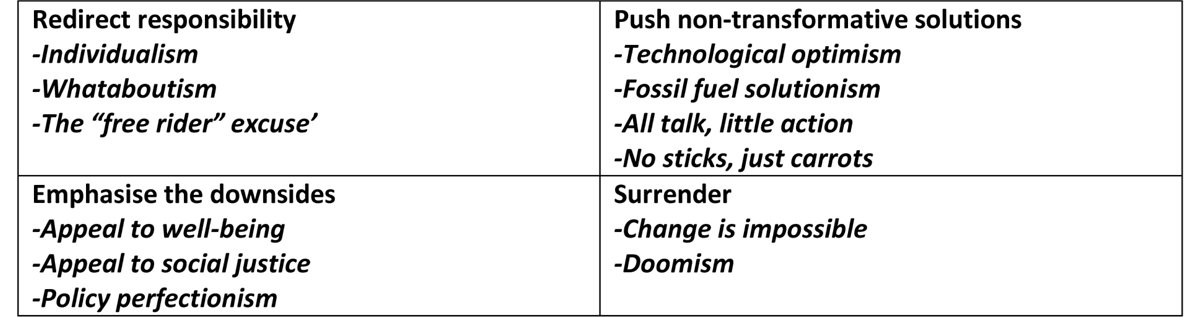
Lamb et al’s (2020) “Discourses of Climate Delay” framework.
Much of the work inspired by Lamb et al (2020) has examined policy debates. In our case, we chose to explore opposition to LTNs in the discourses of people encountering LTNs in their everyday lives. This is based on an understanding that embodied discursive practices are powerful tools for embedding and sustaining discourses around mobility (Doughty and Murray, 2016) and that discursive practice is key to understanding emergent urban infrastructure (Haughton and McManus, 2022). By focusing on how people make sense of these disruptions, we aim to identify in what ways (some of) the discourses identified by Lamb et al shape people’s narration of opposition to LTNs.
While Lamb et al’s work has proved a fruitful avenue for analysing a variety of discourses, Pflieger and De Pryck (2023) have also highlighted limitations. Discourses do not exist alone and must be seen in relation to the roles of different actors and local political contexts (Zografos et al 2020; Hickman and Sallo, 2022). In analysing public rather than policy discourses, we are exploring their mobilisation by ordinary people rather than (as is often done in analysis) by professionals. Towards the end of the article, we reflect on this point, including, in our case, the ways in which the multiple marginalisations experienced by disabled people become enmeshed with pro- and anti-LTN discourses, including those of climate delay.
4 Methods
During the summer of 2022, as part of a larger mixed-method study examining the impacts of LTNs introduced in London, we undertook 81 go-along interviews with residents living in or near two implemented and two planned London LTNs. To recruit participants, we flyered all homes both within the case study LTNs, and on the surrounding (“boundary”) roads with a screening questionnaire. This sought demographic data as well as their position (support, oppose, ambivalent, unaware) on the local LTN. From each case study LTN, we selected 20 participants to represent a diversity of demographics, views on the LTN, and locations. We used walking or wheeling1 go-along interviews, as this is a method particularly suited to enable insight into participants’ embodied experiences of engaging with and responding to the environment that they are moving through (Carroll, Jespersen and Troelsen, 2020; Jones and Spencer, 2024). Interviews were audio recorded, and GPS tracked. Anonymised transcripts were then analysed using NVivo. The study received ethical approval by the University of Westminster Research and Knowledge Exchange Ethics Committee.
Much interview content covers how residents are making sense of their locally planned or implemented LTN, and ways in which residents narrate support or opposition. The full interview set has been analysed in other publications (Larrington-Spencer et al. 2024; Verlinghieri et al. 2025a, 2025b; Verlinghieri et al. 2026; Larrington-Spencer et al. In print). The 81 interviews were initially coded using a mixed deductive/inductive coding framework that focused on the impacts of LTNs on the self and others, as well as other recurring themes in the debate about LTNs(Larrington-Spencer et al. In print). During the analysis, we observed discourses resonating with Lamb et al’s categories in interviews with participants who opposed the schemes. We therefore decided to conduct a second analysis, focusing upon how climate delay is entangled within such opposition narratives. To do so, we selected the 33 residents (P1–P33) who answered that they opposed or strongly opposed the LTN in our screening questionnaire. Participant demographics provided in Appendix 1.
5 Discourses of climate delay in LTN discussions
The delay discourses that emerged within everyday opposition to LTNs are displayed in Figure 3 and discussed below. Whilst we classify participant discourses to one specific form of delay, there are overlaps between the different categories, which are discussed within the analysis. In our findings section, we consider whether opposition discourses cohere or not with the discourses of delay framework, better informing our understanding of LTN controversies. In the subsequent discussion, we further reflect on the way in which oppositional discourses on LTNs, by adhering or diverging from the discourses of delay framework, can enrich the categories identified by Lamb et al by considering their application within a more popular discourse context.
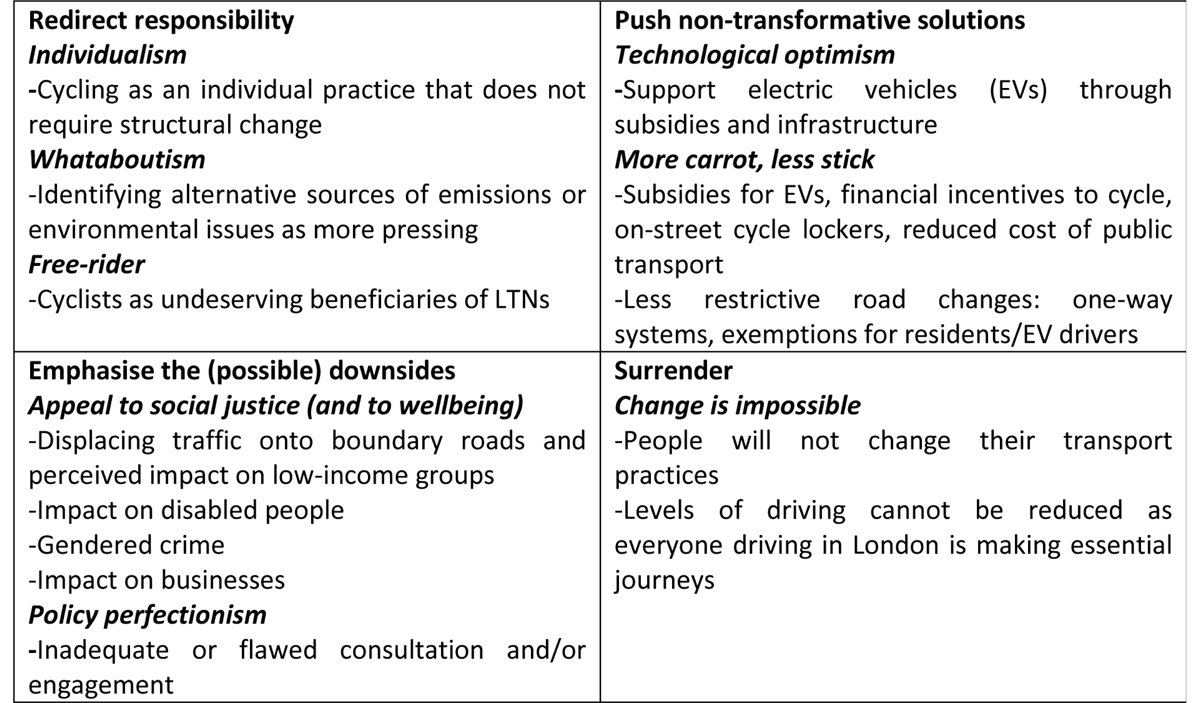
Discourses of climate delay emerging within everyday opposition to LTNs according to Lamb et al’s 2020 framework.
5.1 Redirect responsibility
The first discourse of delay is to “redirect responsibility” for climate mitigation. Lamb et al (2020) identify three aspects of redirecting responsibility. The first is “individualism”, which involves redirecting attention from systemic change to individual solutions. The second is “whataboutism”, in which attention is redirected to other sources of emissions that should instead be tackled. The third is the “free-rider excuse”, which is the concern that undeserving others will take advantage of mitigation attempts. This section looks at the deployment of these discourses within opposition to LTNs.
5.1.1 Individualism
“Individualism” in everyday opposition to LTNs was observed in a recurring discursive construction of cycling as an individualised practice. Individualisation of cycling uptake through, for instance, a focus on individual training is contradicted by evidence that shows the importance of safer infrastructure for cycling rates (Aldred and Goodman, 2020; Knight and Charlton, 2022), as well as for diversity in terms of who is cycling (Aldred et al, 2017). Discourses around individualism have also been identified in wider active travel scholarship. For instance, Egan’s (2021) study of cycling in Dublin and ways in which those who cycled were expected, or felt compelled, to take responsibility for the risk imposed on them by others.
In our data, individualism operated through consideration that those who would cycle already do so, irrespective of whether there is an LTN. For example, P5 felt that “a cyclist with or without the LTN, it doesn’t affect them at all, their journey, or safety, or whatever reason is still roughly the same”, and P14 discusses how their next-door neighbour who “uses a bike most times to get to work” means that “this road doesn’t need it, it does not need an LTN”. This individualisation can also be considered a discourse of surrender (see Section 5.4) as positing that those who cycle will cycle and those who drive will drive offers no potential for modal shift between these categories. Cycling was further individualised by perceptions that people who cycle need formal training—“I think there should be training, you need to have a licence to ride a bicycle” (P29)—rather than infrastructural change to improve safety.
5.1.2 Whataboutism
“Whataboutism” was commonly identified in everyday opposition to LTNs through participants’ redirection of attention away from the problems that LTNs seek to address—namely, too many vehicle journeys and the ensuing emissions, air pollution, and road deaths, and serious injuries – and towards alternative environmental problems that should be addressed instead. For example, P29 redirected attention to pollution from freight and aviation, P33 to CO2 emissions from agriculture, and P30 drew attention towards their local authority not doing enough to support recycling.
In highlighting whataboutism, the intention is not to say that these other forms of emissions or environmental problems identified are not pertinent. Rather, the intention is to demonstrate how the identification of an alternative environmental problem is deployed to redirect attention away from a radical form of climate intervention that would disrupt automobility. Additionally, the identification of alternative sources of emissions or environmental problems is commonly verbalised as an “or” rather than as an “and” by participants. By this, we mean narrative framing by participants is that only one environmental issue can be targeted, thereby delegitimising LTNs as a form of mitigation if there are alternative, more pressing issues in occurrence.
5.1.3 Free-rider concerns
Free-rider concerns emerged largely in relation to cyclists. In general, cyclists were perceived to be irresponsible in their use of LTNs as a public space. Participants mobilised discourses around competence and legitimacy, resonating strongly with those highlighted by Aldred (2013) in the creation of cycling stigma, and Caimotto (2023) in analysing the construction of the “reckless cyclist”. Cyclists in our data were constructed as “abusing their freedom” (P29), “not stopping at red lights” (P27), and having “no road sense” (P32) and “no common sense” (P25). Constructing the cyclist as an irresponsible beneficiary of LTNs is a form of free-riding in terms of considering that cyclists benefit from an LTN but do not adhere to the same levels of regulation and law (supposedly) as drivers.
5.2 Push non-transformative solutions
The second discourse of climate delay, “push non-transformative solutions” involves the promotion of solutions that only partially aim to mitigate climate change and so draw attention away from more radical and transformative change. Lamb et al (2020) identify multiple aspects of this discourse. The first is “technological optimism”, in which technology is considered to offer the opportunity to enable rapid reductions of emissions in the future. The second is “fossil fuel solutionism”, in which fossil fuels are positioned as part of the solution to tackling climate change. The third is “all talk no action”, in which limited successes are used to downplay the need for more transformative solutions and to limit the scope of any intervention. Finally, Lamb et al (2020) identify an ideological discourse of “no stick, just carrots”, in which non-restrictive interventions are preferred over restrictive interventions. The following section looks at the deployment of “technological optimism” and “no stick, just carrots” forms of discourse that push non-transformative solutions within everyday opposition to LTNs, as other discourses within this category were not identified.
5.2.1 Technological optimism
In our study, “technological optimism” within everyday opposition to LTNs primarily emerged through the popular consideration by participants that EVs are a desirable alternative to combatting the urban challenges that necessitate an LTN. In addition to providing financial support for the purchasing of EVs, participants felt that EV uptake should be supported through on-street charging provision.
Widespread technological optimism around EVs as a solution to the “transport problem” goes beyond the debate on LTNs, with research highlighting how such transportation techno-optimism overlooks structural challenges, unintended consequences, and the need for wider systemic change (Etesami, Raufi and Maniat, 2024). Critics of EVs optimism’s shaky foundations (Henderson, 2020; Li, Leung and Probyn, 2025) show that how EVs are, at best, a partial solution—insufficient to achieve net zero in the UK (Dillman et al, 2020; Morgan, 2020)—and that they fail to reduce physical inactivity and road injuries (CMO, 2022).
5.2.2 No stick, just carrots
LTNs as an intervention seek to combine both carrot, safer and more pleasant walking, wheeling, and cycling conditions, and stick, disincentivising vehicle journeys by making routes more circuitous (Thomas and Aldred, 2023). Participants who opposed LTN implementation tended to emphasise the need for “more carrot”—for example, subsidies for EVs, subsidies for purchasing cycles, more storage for cycles, and lowering the cost and improving the provision of public transport, whilst proposing “less stick”, for example, less restrictive interventions like one-way systems or traffic calming rather than modal filters, and LTN exemptions for local residents and/or EV drivers.
This could be considered as a form of “whataboutism”, redirecting attention away from a disruptive and radical intervention, to one that is likely to be less transformative. The more carrot/fewer sticks approach of participants can be viewed through the existing frame of automobility, in which only interventions that do not impact car use are proposed. Within this discussion of carrot and stick, we are not suggesting that “more carrot” interventions identified by participants are unimportant. On the contrary, they are worthwhile and impactful interventions that will support the decarbonisation of transport and increased modal shift from private vehicle use to active travel and public transport. However, “more carrot” alone is unlikely to be sufficient for transformative levels of modal shift without radical and structural changes to road hierarchies (Xiao et al, 2022).
5.3 Emphasise the downsides
The third discourse of climate delay identified by Lamb et al (2020) is “emphasise the downsides”, which involves emphasising that the climate mitigation measure in question will result in greater societal burdens than the problem that it is seeking to resolve. There are multiple aspects of “emphasise the downsides”, including appealing to social justice and highlighting unfair burdens, appealing to wellbeing, and that mitigation will negatively impact living standards, and finally appealing to policy perfectionism, in which it is emphasised that any solution should be supported by all affected parties. We observed “social justice and unfair burden” arguments throughout our go-along interviews with participants, and these tended to overlap with “appealing to wellbeing” through the implication of unfair burdens. “Policy perfectionism” was also identified in everyday opposition to LTNs in critiques of consultation and engagement processes.
5.3.1 Social justice and unfair burdens
Emphases on “social justice” and “unfair burdens” have been common, if sometimes quite disparate threads in everyday opposition to LTNs, analysed in, e.g., Powell (2024). In our data, the most widely discussed social injustice within everyday opposition was the perception that LTNs cause displacement of vehicles onto the boundary roads of schemes. For example, P20 felt that “the biggest effect of all these stupid traffic calming measures is that it has forced more traffic onto this [boundary] road because there’s nowhere else for them to go”, and P32 felt that boundary roads had “clearly become busier and busier and busier”.
Many participants felt that any displacement of vehicles was a greater injustice, as they considered boundary roads to have greater levels of social housing and low-income households. However, there is evidence that residents on London’s main roads are demographically similar to residents on side roads (Aldred and Verlinghieri, 2020) and that those living inside new London LTNs are demographically similar to neighbours living nearby on or close to boundary roads (Aldred et al, 2021). Perceptions here may be at odds with reality, or, perhaps, in individual cases, aggregate findings do not hold true. The findings from our broader project suggests that where there are reduced motor traffic speeds on boundary roads or greater congestion, these are, in most cases, temporary changes, although with exceptions (see also Verlinghieri et al. 2025a).
A further social justice concern discussed was the potential for interventions to negatively impact disabled people. In our research, injustice affecting disabled people was commonly identified by non-disabled participants. For example, P22 discussed how: “I have a very good mate of mine who’s profoundly disabled…. And he’s becoming ever more frustrated by the constraints put on where he can go by these things [LTNs] springing up”. P13 speculated on the difficulties for disabled people living in LTNs to access taxis. It is important to recognise that disabled participants also identified injustices. For example, P25 discussed how she felt increasingly isolated as she could not afford the higher taxi fare for the more circuitous journey to her local high street, and P14, who uses her car as her mobility aid, was concerned that increasing journey length would increase her arthritic pain.
Disabled-led research by Transport for All (2021) on disabled people’s experiences of LTNs highlights a mix of negative and positive impacts, stressing the diversity of experiences and the need for both mitigation and changes to the status quo. We have discussed more in detail how LTNs impact the experiences of those walking or wheeling with mobility aids in another paper (Verlinghieri et al. 2025b). Additionally, many LTN schemes, including those studied, have dispensations for blue badge holders to mitigate the impact upon disabled people who rely upon their vehicles as mobility aids. A tension within our analysis is where a discourse of delay—often related to social inequity in the distribution of their costs and benefits—is constructed by creating a universalising narrative extrapolating legitimate concerns about possible negative implications of a specific intervention on marginalised groups. This is discussed more in Section 6.2.
5.3.2 Policy perfectionism
“Policy perfectionism” emerged within everyday opposition to LTNs through perspectives that consultation and engagement processes were insufficient or inadequate. There was often also a perception by those who opposed the implementation of LTNs that the consultations were a “foregone consultation” (P23) and that local authorities were going to implement schemes irrespective of resident feedback: “there’s a tendency to think things have been predetermined and some consultation has gone on which has given them the green light to do that” (P27). Additionally, it was perceived that because LTNs were implemented as trials and so consultation and engagement happened over an extended period of time, that “a fatigue creeps in” (P18). Ensuring appropriate deliberation and decision-making processes is central to climate mitigation policy and action (Willis, Curato and Smith, 2022; Verlinghieri, Vitale Brovarone and Staricco, 2023). However, the instance we highlighted here points to an unconstructive race to perfection, where contestation of policy processes is mobilised only when the outcome of such a process is in contrast with individual preferences (i.e., by those who oppose the scheme), rather than as an invitation to improve deliberation and use engagement processes to address equity concerns or improve schemes.
5.4 Surrender
The final discourse of climate delay discussed in this section is surrender, in which discourse raises doubts that mitigation is possible, “pointing to seemingly insurmountable political, social, or biophysical challenges” (Lamb et al, 2020, p.4). One aspect of surrender discourse is emphasising that “change is impossible” because any form of mitigation would have an insurmountable impact upon ways of life. The second aspect is “doomism”, where climate change is considered locked in, and mitigation therefore perceived as futile. “Change is impossible” forms of discourse within opposition to LTNs emphasise that either any modal shift from private vehicles to other forms of transport was simply impossible or that current levels of car use reflect only essential journeys, and therefore, there cannot be any modal shift. We did not observe “doomism” within go-along discussions.
5.4.1 Change is impossible
One form of “change is impossible” discourse within everyday opposition to LTNs is that such interventions are futile because drivers will not change their behaviour. Such a discourse is constructed both by conceptualising traffic flows as an unchangeable given subject of public space—for example, “the traffic ain’t going to disappear, vehicles are not going to disappear” (P29)—as well as by mobilising driver behaviour as an unchangeable inevitability—for example, “people are not going to give up their cars, that’s the long and short of it, they will not” (P8). Reinforcing this “change is impossible” discourse around driver behaviour were discourses that constructed all vehicle journeys within London as essential. For example, P22 considered “driving in London [as] fundamentally inefficient” and so people do not do it by choice, P30 considered that people are only driving because they have to, and P27 considered that “it’s not people going off for casual drives, a) with the price of petrol people don’t do that”. These two “change is impossible” discourses can be viewed through an automobility lens, understanding that the normalisation of vehicle journeys is so much part of our cultural perspective on how journeys should be made that an alternative mode of transport cannot necessarily be easily conceived (Walker and Brömmelstroet, 2025). Several authors have similarly highlighted how discourses on the perceived immutability of the current status quo on roads broadly recur within automobility (Aldred, 2019; Egan and Caulfield, 2024).
6 Utilising discourses of delay to understand everyday opposition to climate mitigation interventions: opportunities and tensions
Discourses and discursive choices play a key role in transformative urban change as they are a central component in shaping what aspects of climate mitigation will be supported or foreclosed. Within Section 5, we have applied Lamb et al’s “discourses of climate delay” framework to understand how such discourses emerge within everyday opposition to LTNs. Whilst we can identify discourses related to most categories within Lamb et al’s framework, it is interesting to note those for which we did not find examples. These were “doomism”, under “Surrender”, and “all talk, little action” and “fossil fuel solutionism” under “Pushing non-transformative solutions”. The latter two are likely not present because they relate to larger policy debates (from which the framework was originally developed). However, the absence of doomism could potentially signify that participants did not necessarily consider LTNs as a form of climate change mitigation. As a consequence, they did not necessarily evoke the inevitability of climate change and related doomism present in Lamb et al’s analysis. Indeed, whilst LTNs are often proposed to combat transport-related carbon emissions, as previously mentioned, they are also utilised to achieve additional goals related to air quality, road safety, and physical activity.
Overall, in our analysis, most discourses from participants who oppose LTNs resonated with the discourses of climate delay framework, even if participants themselves did not necessarily articulate LTNs as a form of climate change mitigation. Therefore, we can argue that such a framework is not only relevant to the everyday sense-making of climate interventions but can also help analyse other processes, including transformative interventions that seek to challenge prevailing paradigms governing everyday life.
Below, reflecting on our application of the discourses of climate delay to LTN opposition, we consider both the opportunities and the tensions that emerge from using the framework to investigate the everyday sense-making of and responses to a climate mitigation intervention.
6.1 Opportunities in applying the discourses of climate delay to everyday opposition to climate mitigation measures, such as LTNs
As demonstrated by the application of the discourses of climate delay framework to everyday opposition of LTNs, there is a strong relevance of the framework to the discourses used by residents to articulate their opposition to LTN implementation. This application offers the opportunity to understand opposition to LTNs by residents as more complex than individual opinions on the scheme developed only through lived experience. The framework helps to highlight how opposition to a specific scheme is formed as part of wider processes of opposition to climate mitigation, even where the scheme is not explicitly framed or perceived as climate mitigation action. These, in turn, in the case of interventions related to everyday mobilities, intertwine with and are strengthened by discourses typical of automobility (Böhm et al, 2006). Obviously, there are tensions within this regarding recognising the difference between articulating a very real social injustice and articulating a discourse of delay, which will be discussed more in Section 6.2.
Being able to make visible the strategies used to downplay the necessity of implementing a radical form of climate mitigation is important, and even more so because of the level of backlash that LTNs in the UK, like many other transport-related climate mitigation interventions (Field et al, 2018), face. Indeed, there are many examples of LTNs being vandalised and accounts of local authority officers, as well as local councillors, receiving abuse and even death threats because of LTN implementation (Elledge, 2022). Being able to recognise discourses of delay in response to reorienting road priorities as climate mitigation offers possibilities for those seeking to implement such measures and who are experiencing the public and political backlash as a result, to be able to situate this backlash both within a context of climate mitigation and disrupting motonormativity, but also more broadly within disrupting the normative structures that govern everyday life.
6.2 Tensions in applying the discourses of climate delay to everyday opposition to climate mitigation measures
A very significant tension that we feel has emerged through our analysis of discourses of climate delay in opposition to LTNs is in terms of everyday articulations of social justice and unfair burdens (see Section 5.3.1) and where to draw the distinction between a discourse being of delay, minimising the need for radical change, and a discourse that highlights very real actual or potential injustices to self or others because of an LTN. Discourses of delay often build on legitimate social concerns. Indeed, it is generally because they are legitimate concerns that discourses of delay are often so effective (Lamb et al, 2020, p.5). It is, therefore, essential that they are carefully considered and addressed within climate mitigation measures, including LTNs. A similar tension has been identified by Harry, Maltby and Szulecki (2024) in their study of labour environmentalism and discourses of delay and the ways that trade unions and industrial workers are often implicated in the resistance to environmental transitions with little regard for structural power relations from labour as opposed to from capital.
This is a difficult tension as it is particularly vulnerable to weaponisation, where unfair impacts are deployed to foreclose changes altogether rather than as a means of giving voice to the concerns so that the changes can be improved upon. However, within this (and within the discourses of delay framework more broadly), there is the implicit assumption that climate change policies and mitigation interventions cannot be regressive, which is not necessarily true. Many transport or environmental policies and interventions of all kinds do potentially generate unintended and negative consequences, often for marginalised groups such as disabled people (Larrington-Spencer et al, 2021), low-income groups, or ethnically minoritised groups (Büchs, Bardsley and Duwe, 2011; Ray and Sibara, 2017). In such a way, framing concerns as discourses of climate delay can risk negating the realities of marginalised groups, rather than providing recognition and remedy to them. This in turn promotes further social injustice as recognising and addressing inequalities provides “conditions for ambitious climate action” (Pflieger and De Pryck, 2023, p.1).
Like Harry, Maltby and Szulecki (2024), as well as Pflieger and De Pryck (2023), we consider that this tension emerges from the risk that discourses of climate delay oversimplify the complexity of the debate at hand. This is because whilst a social justice discourse could be shared—for example, the potential negative impact of an LTN on a disabled person—such a shared discourse can still “refract differential positions within a global political economy of social divisions” (Harry, Maltby and Szulecki, 2024, p.6). For example, this discourse can equally be used by a low-income disabled person experiencing very real impacts on their mobility and social inclusion because of an LTN through an increase in the cost of taxis and also used by a home-owning, non-disabled person who can afford to own and run a car and who resents having a few minutes added to their occasional journey (both real examples from participants in the study). As discussed also by Verbeek (2018) in their study of concerns related to noise pollution, a social and epistemic justice approach to transport interventions means that where concerns emerge from and how they are articulated is carefully considered (see also Smeds et al 2023). At the same time, we argue that, in the differentiation between discourses of delay and real concerns, a reflection should also be made on the type of remedies proposed. As we show in the analysis of discourses related to LTNs, there is a difference between highlighting a negative effect as a reason for removing the whole intervention (a discourse of delay) and residents highlighting negative effects and pointing to specific modifications to the intervention to address them.
7 Conclusion
Within this paper, we have applied Lamb et al’s (2020) discourses of climate delay framework to the everyday opposition to LTNs that emerged within 33 out of 81 go-along interviews with residents living in or near two implemented and two planned London LTNs in the summer of 2022. Through this application, we have identified how discourses of climate delay are produced within everyday accounts of transformative climate mitigation and how, considering that not all participants necessarily articulated LTNs as a form of climate mitigation, the framework has a wider applicability to transformative interventions that seek to challenge prevailing paradigms governing everyday mobility and life.
Through the application of the discourses of delay framework to everyday opposition to LTNs, we have identified opportunities in terms of understanding opposition not only as an individual condition, but as part of broader discursive formations. Visibilising and understanding discourses related to LTNs (and climate mitigation interventions more widely) in this way can help policymakers and others involved within their implementation understand and make sense of the backlash that they may experience and support driving forward change.
A substantial tension that emerges, however, is the potential of the framework to oversimplify diffractive positions that can share similar discourses, and how this could result in very real articulations of social injustice and unfair burdens being labelled as delay. As we have shown with the example of disabled people and LTNs, negative effects on marginalised groups need to be addressed to ensure that climate change mitigation is just. And this will mean attending to the differential positions that can be refracted within a shared and dominant discourse. Whilst the discourses of delay framework can potentially simplify these refractive positions, we would pose that attending to the everyday nature of discourses around climate mitigation (and, in this case, LTNs) can serve to reveal these refractions. Reflecting on this, we pose that future research on discourses of delay and everyday forms of climate mitigation should attend more deeply to these refractive positions, and how we can disrupt the obfuscation of legitimate concerns and in turn enable such legitimate concerns to be given a clearer voice and support the development of more ambitious and more just climate action (Pflieger and De Pryck, 2023).
Appendix 1
| Paper ID | Gender | Age | Ethnicity | Car/van ownership | Disability |
| P1 | Female | 40–49 | Black, African, Caribbean or Black British | One | No |
| P2 | Male | 70+ | White | None | No |
| P3 | Male | 40–49 | Asian or Asian British | One | No |
| P4 | Female | 50–59 | Asian or Asian British | Two or more | No |
| P5 | Male | 40–49 | Asian or Asian British | One | No |
| P6 | Female | 30–39 | Mixed or multiple ethnic groups | One | No |
| P7 | Female | 70+ | White | One | No |
| P8 | Female | 60–69 | White | Two or more | No |
| P9 | Female | 70+ | Not disclosed | One | Yes |
| P10 | Male | 30–39 | White | Two or more | No |
| P11 | Female | 30–39 | Black, African, Caribbean or Black British | One | No |
| P12 | Female | 30–39 | White | None | No |
| P13 | Male | 18–29 | White | None | No |
| P14 | Female | 50–59 | White | One | Yes |
| P15 | Female | 30–39 | Mixed or multiple ethnic groups | One | Yes |
| P16 | Male | 40–49 | White | One | No |
| P17 | Male | 60–69 | White | One | No |
| P18 | Male | 60–70 | White | One | Not disclosed |
| P19 | Female | 50–59 | White | One | No |
| P20 | Female | 60–69 | White | None | Yes |
| P21 | Male | 70+ | Asian or Asian British | One | No |
| P22 | Male | 40–49 | White | Two or more | No |
| P23 | Female | 70+ | White | One | No |
| P24 | Female | 40–49 | White | One | Yes |
| P25 | Female | 30–39 | Not disclosed | None | Yes |
| P26 | Female | 50–59 | White | None | No |
| P27 | Male | 70+ | Not disclosed | One | No |
| P28 | Male | 40–49 | Jewish | None | No |
| P29 | Male | 60–69 | Mixed or multiple ethnic groups | One | No |
| P30 | Male | 40–49 | White | One | No |
| P31 | Female | 60–69 | Not disclosed | None | No |
| P32 | Male | 50–59 | White | One | No |
| P33 | Male | 50–59 | Not disclosed | Two or more | No |
Notes
- Wheeling indicates moving as a pedestrian using a wheeled mobility aid, such as a wheelchair, mobility scooter, or rollator (Transport for All, no date). ⮭
Acknowledgements
This study is funded by the NIHR [Research Award (NIHR135020)]. The views expressed are those of the author(s) and not necessarily those of the NIHR or the Department of Health and Social Care.
The authors would like to thank research participants for the involvement in this research. They would also like to extend their thanks to reviewers.
Funding Information
The authors disclosed receipt of the following financial support for the research, authorship and/or publication of this article: This work was supported by the National Institute for Health and Care Research (grant number NIHR135020).
Competing Interests
The authors have no competing interests to declare.
References
Aldred, R. (2013) ‘Incompetent or too competent? Negotiating everyday cycling identities in a motor dominated society’, Mobilities, 8(2), pp. 252–271. Available at: http://doi.org/10.1080/17450101.2012.696342
Aldred, R. (2018) ‘Inequalities in self-report road injury risk in Britain: A new analysis of National Travel Survey data, focusing on pedestrian injuries’, Journal of Transport & Health, 9, pp. 96–104. Available at: http://doi.org/10.1016/j.jth.2018.03.006
Aldred, R. (2019) ‘Who caused that congestion? Narrating driving and cycling in a changing policy context’, Travel Behaviour and Society, 16, pp. 59–69. Available at: http://doi.org/10.1016/j.tbs.2019.04.004
Aldred, R. and Goodman, A. (2020) ‘Low traffic neighbourhoods, car use, and active travel: Evidence from the people and places survey of outer London active travel interventions transport findings’, Transport Findings. Available at: http://doi.org/10.32866/001c.17128
Aldred, R. and Verlinghieri, E. (2020) LTNs for all? Mapping the extent of London’s new Low Traffic Neighbourhoods. Available at: https://policycommons.net/artifacts/1439909/ltnsforall3/2067510/ (Accessed: 3 May 2022).
Aldred, R. et al. (2017) ‘Cycling provision separated from motor traffic: A systematic review exploring whether stated preferences vary by gender and age’, Transport Reviews, 37(1), pp. 29–55. Available at: http://doi.org/10.1080/01441647.2016.1200156
Aldred, R. et al. (2021) ‘Equity in new active travel infrastructure: A spatial analysis of London’s new Low Traffic Neighbourhoods’, Journal of Transport Geography, 96, pp. 966–6923. Available at: http://doi.org/10.1016/j.jtrangeo.2021.103194
Böhm, S. et al. (2006) ‘Introduction: Impossibilities of automobility’, The Sociological Review, 54(1_suppl), pp. 3–16. Available at: http://doi.org/10.1111/j.1467-954X.2006.00634.x
Braun, R. and Randell, R. (2023) ‘Towards post-automobility: destituting automobility’, Applied Mobilities, 8(3), pp. 201–217. Available at: http://doi.org/10.1080/23800127.2022.2071664
Büchs, M., Bardsley, N. and Duwe, S. (2011) ‘Who bears the brunt? Distributional effects of climate change mitigation policies’, Critical Social Policy, 31(2), pp. 285–307. Available at: http://doi.org/10.1177/0261018310396036
Caimotto, M. C. (2023) ‘‘Cycling is good’ but ‘cyclists are reckless’’, Journal of Language and Discrimination, 7(1), pp. 52–74. Available at: http://doi.org/10.1558/jld.24428
Carroll, S., Jespersen, A. P. and Troelsen, J. (2020) ‘Going along with older people: exploring age-friendly neighbourhood design through their lens’, Journal of Housing and the Built Environment, 35(2), pp. 555–572. Available at: http://doi.org/10.1007/s10901-019-09700-z
CMO. (2022) Chief Medical Officer’s Annual Report 2022: Air Pollution. Department of Health and Social Care. Available at: https://www.gov.uk/government/publications/chief-medical-officers-annual-report-2022-air-pollution. (Accessed: 3 May 2024).
Cox, P. (2023) ‘Vélomobility is to degrowth as automobility is to growth: Prefigurative cycling imaginaries’, Applied Mobilities, 8(3), pp. 265–285. Available at: http://doi.org/10.1080/23800127.2022.2087134
Curl, A., Clark, J. and Kearns, A. (2018) ‘Household car adoption and financial distress in deprived urban communities: A case of forced car ownership?’, Transport Policy, 65, pp. 61–71. Available at: http://doi.org/10.1016/j.tranpol.2017.01.002
DfT. (2021) Decarbonising Transport – A Better, Greener Britain. Department for Transport. Available at: https://assets.publishing.service.gov.uk/media/610d63ffe90e0706d92fa282/decarbonising-transport-a-better-greener-britain.pdf. (Accessed: 3 May 2026)
Dillman, K. J., et al. (2020) ‘Review and meta-analysis of EVs: Embodied emissions and environmental breakeven’, Sustainability, 12(22), p. 9390. Available at: http://doi.org/10.3390/SU12229390
Doughty, K. and Murray, L. (2016) ‘Discourses of mobility: Institutions, everyday lives and embodiment’, Mobilities, 11(2), pp. 303–322. Available at: http://doi.org/10.1080/17450101.2014.941257
Egan, R. (2021) ‘‘Provoking responsibility’: The struggle for recognition as an everyday cyclist in Dublin City’, Geoforum, 127, Pp. 23–32. Available at: http://doi.org/10.1016/j.geoforum.2021.09.012.
Egan, R. and Caulfield, B. (2024) ‘There’s no such thing as cycle traffic: A critical discourse analysis of public opposition to pro-cycle planning’, Journal of Cycling and Micromobility Research, 2, p. 100014. Available at: http://doi.org/10.1016/j.jcmr.2024.100014
Elledge, J. (2022) ‘Arson, death threats and ‘eco-crazy councils’: Low-traffic neighbourhoods are dividing England’, The Guardian, 22 April. Available at: https://www.theguardian.com/commentisfree/2022/apr/22/england-low-traffic-neighbourhoods-provoke-fury-local-elections (Accessed: 3 May 2024).
Etesami, S., Raufi, P. and Maniat, M. (2024) ‘New technology and primary energy consumption in the transportation sector: A critical discourse analysis’, Journal of Technology In nov ations and Energy, 3(4), pp. 15–31. Available at: http://doi.org/10.56556/jtie.v3i4.1090
European Commission. (2023). Road transport: Reducing CO2 emissions from vehicles. Available at: https://climate.ec.europa.eu/eu-action/transport/road-transport-reducing-co2-emissions-vehicles_en (Accessed: 23 November 2023).
Fairclough, N. (1989) Language and power. Longman. Available at: http://www.gbv.de/dms/bowker/toc/9780582031333.pdf (Accessed: 5 February 2024).
Featherstone, M., Thrift, N. and Urry, J. (eds.) (2005) Automobilities, 1st edition. SAGE Publications Ltd.
Field, A., et al. (2018) ‘Encountering bikelash: Experiences and lessons from New Zealand communities’, Journal of Transport & Health, 11, pp. 130–140. Available at: http://doi.org/10.1016/j.jth.2018.10.003
Furlong, J., et al. (2025) ‘Low traffic neighbourhoods in London reduce road traffic injuries: A controlled before-and-after analysis (2012–2024)’, Injury Prevention. Available at: http://doi.org/10.1136/ip-2024-045571 (Accessed: 28 July 2025).
Goodman, A., et al. (2023) ‘The impact of 2020 low traffic neighbourhoods on levels of car/van driving among residents: Findings from Lambeth, London, UK’, Findings. Available at: http://doi.org/10.32866/001c.75470 (Accessed 6 February 2024).
Goodman, A., Urban, S. and Aldred, R. (2020) ‘The impact of low traffic neighbourhoods and other active travel interventions on vehicle ownership: Findings from the Outer London Mini-Holland Programme’, Transport Findings. Available at: http://doi.org/10.32866/001c.18200
Harry, S. J., Maltby, T. and Szulecki, K. (2024) ‘Contesting just transitions: Climate delay and the contradictions of labour environmentalism’, Political Geography, 112, p. 103114. Available at: http://doi.org/10.1016/j.polgeo.2024.103114
Haughton, G. and McManus, P. (2022) ‘Becoming WestConnex – Becoming Sydney: Object-oriented politics, contested storylines and the multi-scalar imaginaries of building a motorway network in Sydney, Australia’, Environment and Planning C: Politics and Space, 40(4), pp. 913–932. Available at: http://doi.org/10.1177/23996544211050941
Hayes, S., Gabbatiss, J. and Butler, C. (2025) ‘From climate scepticism to discourses of delay in UK editorials’, Public Understanding of Science, 34(7), 832–851. Available at: http://doi.org/10.1177/09636625251315446
Henderson, J. (2020) ‘EVs are not the answer: A mobility justice critique of electric vehicle transitions’, Annals of the American Association of Geographers, pp. 1–18. Available at: http://doi.org/10.1080/24694452.2020.1744422
Hickman, R. and Sallo, H. K. (2022) ‘The political economy of streetspace reallocation projects: Aldgate Square and Bank Junction, London’, Journal of Urban Design, 27(4), pp. 397–420. Available at: http://doi.org/10.1080/13574809.2022.2033113
Jones, T. and Spencer, B. (2024) ‘Far from the “dreaming spires”: Staging active travel in suburban Oxford, UK’, Applied Mobilities, 9(1), pp. 38–62. Available at: http://doi.org/10.1080/23800127.2024.2316413
Knight, A. and Charlton, S. G. (2022) ‘Protected and unprotected cycle lanes’ effects on cyclists’ behaviour’, Accident Analysis & Prevention, 171, p. 106668. Available at: http://doi.org/10.1016/j.aap.2022.106668
Lamb, W. F., et al. (2020) ‘Discourses of climate delay’, Global Sustainability, 3, e17. Available at: http://doi.org/10.1017/sus.2020.13
Larrington-Spencer, H., et al. (2021) ‘Disabled environmentalisms’, Diversity and Inclusion in Environmentalism. Available at: https://ebrary.net/149404/environment/disabled_environmentalisms (Accessed: 9 September 2022).
Larrington-Spencer, H., Verlinghieri, E., Aldred, R, and Furlong, J. In print. Resident experience of new Low Traffic Neighbourhoods in London. PHR journal.
Larrington-Spencer, H., Verlinghieri, E., Lawlor, E., and Aldred, R. (2024). Troubling go-alongs through the lens of care. Qualitative Research, 25(3). Available at: http://doi.org/10.1177/14687941241277747
Laverty, A. A., Aldred, R. and Goodman, A. (2021) ‘The impact of introducing low traffic neighbourhoods on road traffic injuries’, Transport Findings. Available at: http://doi.org/10.32866/001c.18330
Laverty, A. A., Goodman, A. and Aldred, R. (2021) ‘Low traffic neighbourhoods and population health’, BMJ, 372, n443. Available at: http://doi.org/10.1136/bmj.n443
Li, D., Leung, D. S. -C. and Probyn, E. (2025) ‘Wet dreams: Eco-subjectivity, mineral washing, and the cultural politics of electric mobility’, Continuum, 39(4), pp. 704–718. Available at: http://doi.org/10.1080/10304312.2025.2532135
Lucas, K. (2019) ‘A new evolution for transport-related social exclusion research?’, Journal of Transport Geography, 81, p. 102529. Available at: http://doi.org/10.1016/j.jtrangeo.2019.102529
Mahajan, A. (2023) ‘Highways and segregation’, Journal of Urban Economics, 141, p. 103574. Available at: http://doi.org/10.1016/j.jue.2023.103574
Mason, L. (2021) ‘Low-traffic neighbourhoods – what’s not to like?’, Perspectives in Public Health, 141(2), pp. 70–71. Available at: http://doi.org/10.1177/1757913920985998
Mattioli, G., Lucas, K. and Marsden, G. (2018) ‘Reprint of Transport poverty and fuel poverty in the UK: From analogy to comparison’, Transport Policy, 65, pp. 114–125. Available at: http://doi.org/10.1016/j.tranpol.2018.02.019
Morency, P., et al. (2012) ‘Neighborhood social inequalities in road traffic injuries: The influence of traffic volume and road design’, American Journal of Public Health, 102(6), pp. 1112–1119. Available at: http://doi.org/10.2105/AJPH.2011.300528
Morgan, J. (2020) ‘Electric vehicles: The future we made and the problem of unmaking it’, Cambridge Journal of Economics, 44, pp. 953–977. Available at: http://doi.org/10.1093/cje/beaa022
Oreskes, N. (2004) ‘The scientific consensus on climate change’, Science, 306(5702), pp. 1686–1686. Available at: http://doi.org/10.1126/science.1103618
Pflieger, G. and De Pryck, K. (2023) ‘Contextualizing discourses of climate delay: A response to Lamb et al. (2020)’, Global Sustainability, 6, p. e20. Available at: http://doi.org/10.1017/sus.2023.18
Powell, A. B. (2024) ‘Objectivity vs affect: How competing forms of legitimacy can polarize public debate in data-driven public consultation’, Information, Communication & Society, 28(9), 1523–1540. Available at: http://doi.org/10.1080/1369118X.2024.2329623
Pringle, A. and Robbins, D. (2022) ‘From denial to delay: Climate change discourses in Ireland’, Administration, 70(3), pp. 59–84. Available at: http://doi.org/10.2478/admin-2022-0019
Ray, S. J. and Sibara, J. (eds.). (2017) Disability Studies and the Environmental Humanities: Toward an Eco-Crip Theory. UNP – Nebraska. Available at: http://doi.org/10.2307/j.ctt1p6jht5 (Accessed: 19 October 2022).
Roper, J., Ganesh, S. and Zorn, T. E. (2016) ‘Doubt, delay, and discourse: Skeptics’ strategies to politicize climate change’, Science Communication, 38(6), pp. 776–799. Available at: http://doi.org/10.1177/1075547016677043
SLOCAT. (2023). SLOCAT-Transport Climate and Sustainability Global Status Report-3rd-Edition. SLOCAT. Available at: www.tcc-gsr.com.
Smeds, E., et al. (2023) ‘‘Seeing like a citizen’: Rethinking city street transformations through the lens of epistemic justice: Edited by Emilia Smeds and Ersilia Verlinghieri. Planning Theory & Practice, 24(5), pp. 697–729. Available at: http://doi.org/10.1080/14649357.2023.2273664
Thomas, A. and Aldred, R. (2023) Changes in motor traffic inside London’s LTNs and on boundary roads. Possible. Available at: https://docs.google.com/document/d/13Nsm_GFdH6CpIpPpOZ7hbhLZScgqCAP7ZGI0xi4qDqA/edit#heading=h.e9amstptpyy1. (Accessed: 3 May 2024).
Transport for All. (2021) Pave the way: The impact of Low Traffic Neighbourhoods on disabled people, and the future of accessible active travel. Transport for All. Available at: https://www.transportforall.org.uk/wp-content/uploads/2021/01/Pave-The-Way-full-report.pdf (Accessed: 3 May 2022).
Transport for All. (no date) Walking and Wheeling. Transport for All. Available at: https://www.transportforall.org.uk/the-issues/active-travel/walking-and-wheeling/ (Accessed: 4 September 2025).
Tschoerner-Budde, C. (2020) ‘Cycling policy futures: diversifying governance, expertise and the culture of everyday mobilities’, Applied Mobilities, 5(3), pp. 306–323. Available at: http://doi.org/10.1080/23800127.2020.1766217.
Urry, J. (2004) ‘The ‘system’ of automobility’, Theory, Culture & Society, 21(4–5), pp. 25–39. Available at: http://doi.org/10.1177/0263276404046059
Urry, J. (2007) Mobilities. Polity.
Vandenberg, J. (2024) ‘Plastic politics of delay: how political corporate social responsibility discourses produce and reinforce inequality in plastic waste governance’, Global Environmental Politics, 24(2), pp. 122–145. Available at: http://doi.org/10.1162/glep_a_00745
Verlinghieri, E., Larrington-Spencer, H., Furlong, J., Aldred, R. and Goodman, A. (2025a). Can mixed-methods help us better understand congestion on Low Traffic Neighbourhood boundary roads? J, 128. Available at: http://doi.org/10.1016/j.jtrangeo.2025.104360
Verlinghieri, E., Larrington-Spencer, H., Pathania, A., Goodman, A., Furlong, J., and Aldred, R. (2025b). Walking and wheeling in Low Traffic Neighbourhoods: A mixed methods study of mobility aid users’ interactions with changing public spaces. Cities & Health, 1–20. Available at: http://doi.org/10.1080/23748834.2025.2571279
Verlinghieri, E., Vitale Brovarone, E. and Staricco, L. (2023) The conflictual governance of street experiments, between austerity and post-politics. Urban Studies, 61(5), pp. 878–899. Available at: http://doi.org/10.1177/00420980231193860
Walker, I. and Brömmelstroet, M. te. (2025) ‘Why do cars get a free ride? The social-ecological roots of motonormativity’, Global Environmental Change, 91, p. 102980. Available at: http://doi.org/10.1016/j.gloenvcha.2025.102980
Walker, I., Tapp, A. and Davis, A. (2022) Motornomativity: How social norms hide a major public health hazard. Available at: http://doi.org/10.31234/osf.io/egnmj (Accessed: 17 January 2023).
Ward, H. (2007). Fatal injuries to car occupants: analysis of health and population data. Dept. for Transport.
WHO. (2023) Disability. Available at: https://www.who.int/news-room/fact-sheets/detail/disability-and-health (Accessed: 4 May 2023).
Wild, K., et al. (2018) ‘Beyond ‘bikelash’: Engaging with community opposition to cycle lanes’, Mobilities, 13(4), pp. 505–519. Available at: http://doi.org/10.1080/17450101.2017.1408950
Willis, R., Curato, N. and Smith, G. (2022) ‘Deliberative democracy and the climate crisis’, WIREs Climate Change, 13(2), p. e759. Available at: http://doi.org/10.1002/wcc.759
Xiao, C., et al. (2022) ‘Shifting towards healthier transport: Carrots or sticks? Systematic review and meta-analysis of population-level interventions’, The Lancet Planetary Health, 6(11), pp. e858–e869. Available at: http://doi.org/10.1016/S2542-5196(22)00220-0
Zografos, C., et al. (2020) ‘The everyday politics of urban transformational adaptation: Struggles for authority and the Barcelona superblock project’, Cities, 99, p. 102613. Available at: http://doi.org/10.1016/j.cities.2020.102613